
A Russian city will punish headteachers if pupils wear the hijab. headscarf
The measure has been approved in Nefteyugansk (Western Siberia). The administration reminds everyone that schooling in Russia is secular.
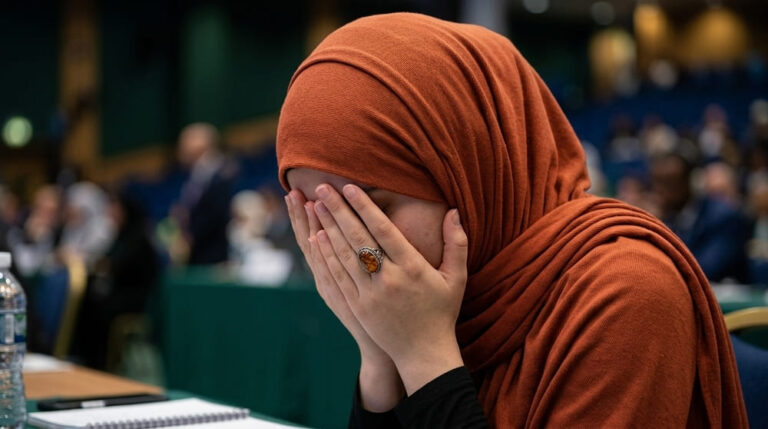
Illustrative image
Generated by AI of Freepik
[social-share align=»right» style=»button» mobile_app=»desktop»]
[social-share align=»center» style=»icon» mobile_app=»mobile»]
In Russia there is no federal law prohibiting the use of religious head coverings in schools. In fact, there is no specific regulation concerning the Islamic headscarf. What does exist is a national standard called GOST, which sets out how school attire should be. According to this document, The students“ uniform must be secular, business-style and without national or religious symbols.. The stated objective is to ensure a neutral, aesthetic and practical appearance in the classrooms. This general framework is what many schools use to draw up their own internal regulations, which may vary according to the region and the management of each centre.
In this context, the city of Nefteyugansk, located in the Khanty-Mansi Autonomous Okrug in Western Siberia, has gone a step further and announced that will sanction school headteachers if pupils attend class with daughterb, he explains it, I would say Slow. In this context, the city of Nefteyugansk has gone a step further and announced that will sanction school headteachers if pupils attend class with headscarf.
It is not the first time that the Islamic veil has generated controversy in Russian classrooms. In the territory of Stavropol and in the region of Vladimir Formal prohibitions have already been approved, backed by local authorities and the courts. In other places, such as the republic of Mordovia, School headteachers have prevented girls wearing veils from entering the classroom, provoking protests and public debate.
The Muslim presence is increasing and the headscarves
The city of Nefteyugansk is part of the autonomous department of Khanty-Mansi, in Western Siberia. It is one of Russia's main oil-producing regions. This energy wealth has attracted thousands of workers from other parts of the country and from former Soviet states, many of whom are Muslim.
This has transformed the demographic composition of the region, where today Russian, Tatar, Chechen, Dagestani and communities from other republics of the Caucasus and Central Asia coexist. Birth statistics show this change: The most popular names for boys and girls are Muhammad and Amina., common in the Islamic sphere. This evolution has been accompanied by occasional tensions: some local media have spoken of the formation of ghettos in neighbourhoods and schools, with little interaction between communities. These social fractures fuel the perception that the headscarf It's not just a piece of clothing, but a visible symbol of differences that generate debate and unease among part of the population.
Parents' outrage at the presence of headscarves
In the region of Kaluga, located a few hundred kilometres from Moscow, two pupils in Year 7 and Year 9 (aged 13 and 15) turned up to class in early September wearing the Islamic veil. The incident provoked outrage among some parents. and forced the centre's management to intervene to explain to the families of the headscarves that school in Russia is secular and that they couldn't take him. The parents wouldn't accept it and the girls stopped attending classes.
The incident escalated to the point that A mother appeared with a lawyer to defend her daughter's right to dress according to her religious beliefs.. The case had a strong media impact and revealed that the issue of the hijab in schools is no longer just a local matter in Siberia, but a topic that divides families, teachers and communities across different regions of Russia.
The Kaluga case reaches the State Duma
Explain the newspaper Izvestia On 18 September, the State Duma of Russia has spoken out on the headscarf in schools following the Kaluga case. Anatoly Vasserman, a member of the Education Committee, He declared that every educational centre has the right to establish its own dress code.. Some centres might even decide that there should be no dress code.
He also emphasised that the canons of Islam They do not require that clothing completely covers the face and body., but they demand modesty. He believes that imposing strict rules on how to dress can be excessive and adds nothing positive to growth, learning or social relationships. At the same time, he pointed out that the official standards (GOST) stipulate that school uniform should be secular and appropriate for educational activities, but that there is some leeway.
«The question of headscarf It must be resolved at a local level.«
Anatoly Vasserman He insisted that the matter must be decided at the level of each centre or each region. This is because lThe Russian political class prefers to decentralise the debate and prevent it from becoming a national dispute..
The plurality of Russia means that perceptions on issues such as the headscarf They vary greatly depending on the territory.. What in Nefteyugansk or Kaluga may provoke outrage and intense debates, In majority-Muslim republics such as Tatarstan, Bashkortostan or Dagestan, it is part of everyday normality.. But even among Muslim regions the practice of Islam is different: for example, Dagestan bans the niqab but in Chechnya it is promoted.
In cities in Western Siberia or in areas near Moscow, where the population is predominantly of Russian and Orthodox origin, the headscarf It is often perceived as a symbol of difference and a cause of conflict. This heterogeneity explains why the Russian authorities prefer to leave regulation in local hands: in Russia, What is controversial in one place can be perfectly ordinary in another..
More about Russia

Even Kadyrov's Islamized Chechnya doesn't want women with their faces covered with the niqab
Muslim leaders in Russia and Central Asia call for ban on niqab and urge against praying in the street
Growing unease in Russia over Muslims praying in the streets
The Republic of Tatarstan (Russia) has drawn up an anti-radicalism plan in response to the rise in hijabs and beards.
The Russian government accuses Muslim leaders of flouting five articles of the Constitution.
Russia announces family-free immigration

More Perceptions of
ERC, PSC and Comuns oppose combating political Islam in the European Parliament.
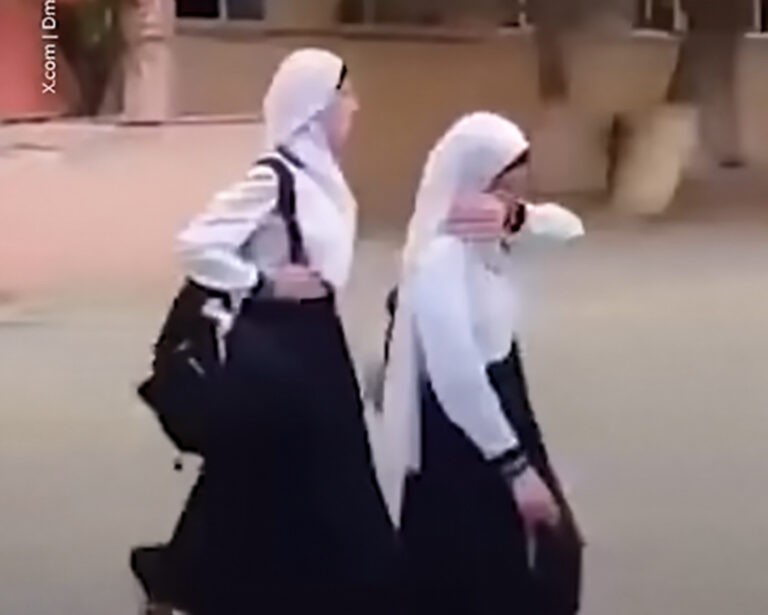
Azerbaijan expels students who wear Islamic headscarves from school
Sharia law in the US is supported by 75% of Muslims, 41% of atheists and up to 20% of Christians.
France now has a halal meat supply without the need to sacrifice animals facing Mecca.
The United Kingdom gives away a thousand hijabs in six months to immigrants arriving via the Channel
US Muslim politicians train Canadian Muslims under the slogan "From the mosque to the city hall"«
Teacher fired in Austria for denying a Muslim woman a prayer room
Canadian government normalizes Islamic prayer during workday
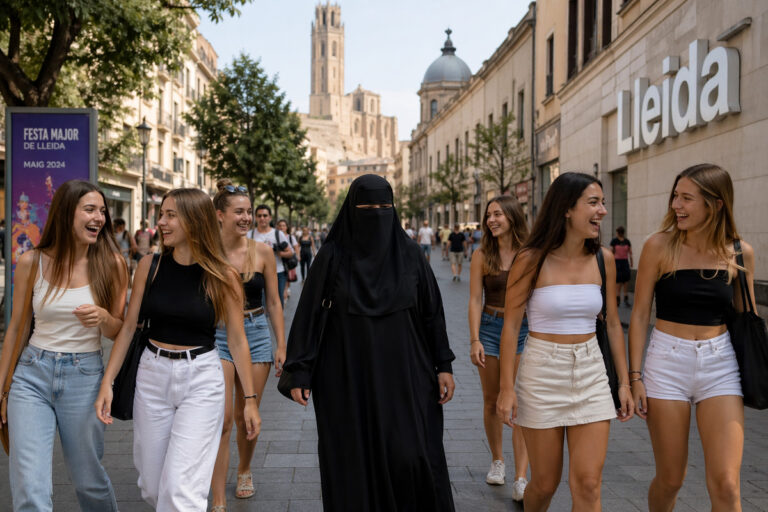
Lleida bans the burqa except if worn for religious reasons
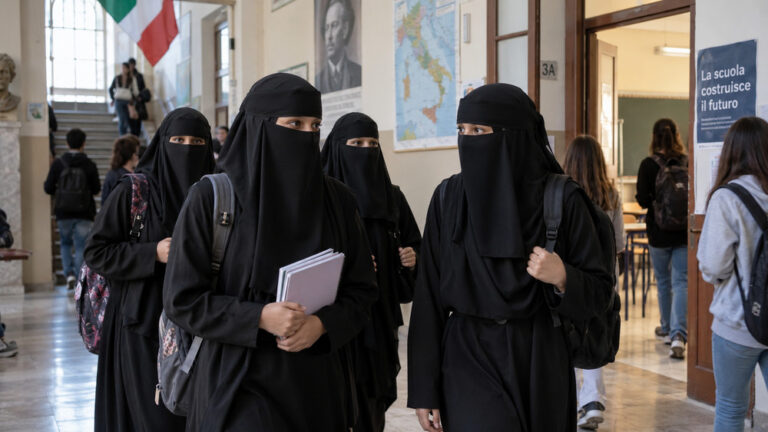
Italy bans burqa and niqab but only in schools
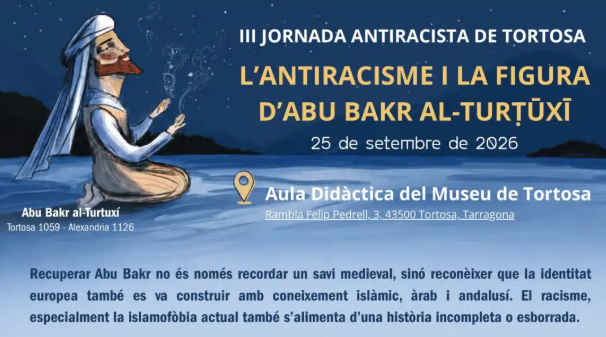
The Generalitat pays tribute to the racist Abu Bakr al-Turtuxí as an anti-racist icon
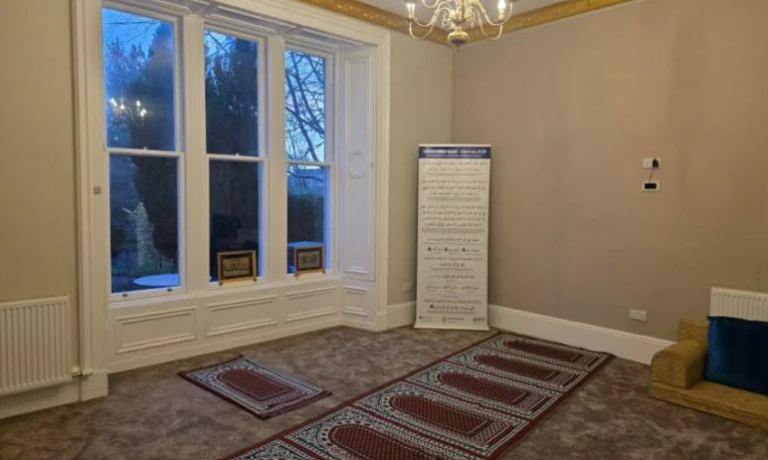
A student residence in Scotland imposes Islamic law in common areas
Kazakhstan threatens to close private schools that allow hijab
A Catholic university in Belgium incorporates Islamic chants into the opening mass of the course

A Muslim family in Granada chooses a Catholic school and demands that the courts teach Islam there
Phrase of the Week

Image of the Week
-Don't you have cousins?