
The Generalitat pays tribute to the racist Abu Bakr al-Turtuxí as an anti-racist icon
The Generalitat and the Tortosa City Council turn a radical religious figure into a "Catalan intellectual" and symbol of the supposed Islamic roots of Catalonia and Europe.
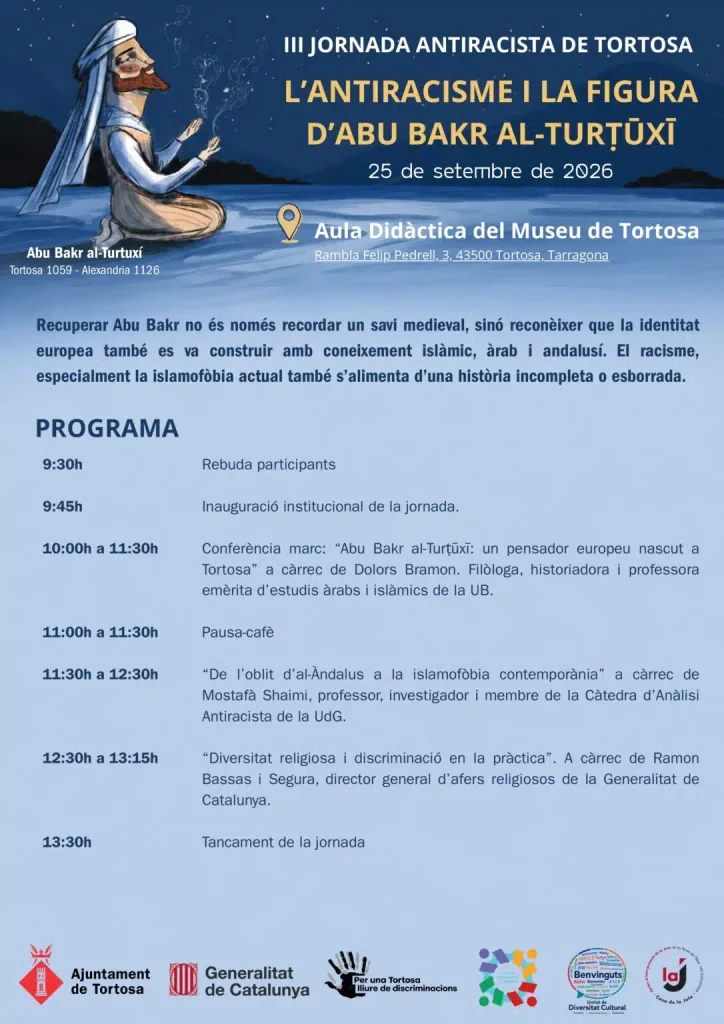
Poster for the anti-racist day in tribute to Abu Bakr of Tortosa
[social-share align=»right» style=»button» mobile_app=»desktop»]
[social-share align=»center» style=»icon» mobile_app=»mobile»]
The Tortosa City Council (ERC) and the Generalitat of Catalonia organise this 25th of September the 3rd Anti-Racist Day of Tortosa, dedicated this year to “Anti-racism and the figure of Abu Bakr al-Turtuxí”. The meeting is part of the programme commemorating the 900th anniversary of the death of the Andalusian jurist and makes clear the interpretation that the institutions want to present of the figure:«Reclaiming Abu Bakr is not just about remembering a medieval scholar, but about recognising that European identity was also built on Islamic, Arab and Andalusian knowledge.».
The intention is not merely historical, nor is it limited to recovering the memory of a supposedly illustrious neighbour. In Abu Bakr al-Turtuxí they have found a useful piece for constructing a new narrative of Catalonia from a decolonial and intercultural perspective. He is not simply presented as an Islamic jurist born in Tortosa, rather as a link in a supposed indigenous cultural tradition that has been erased by contemporary Islamophobia. The mechanism is based, in part, on considering “Catalan thought” anything written in the territory of present-day Catalonia, even if in Arabic and even if, as in the case of al-Turtuxí, the author left Tortosa at around the age of twenty and never returned.
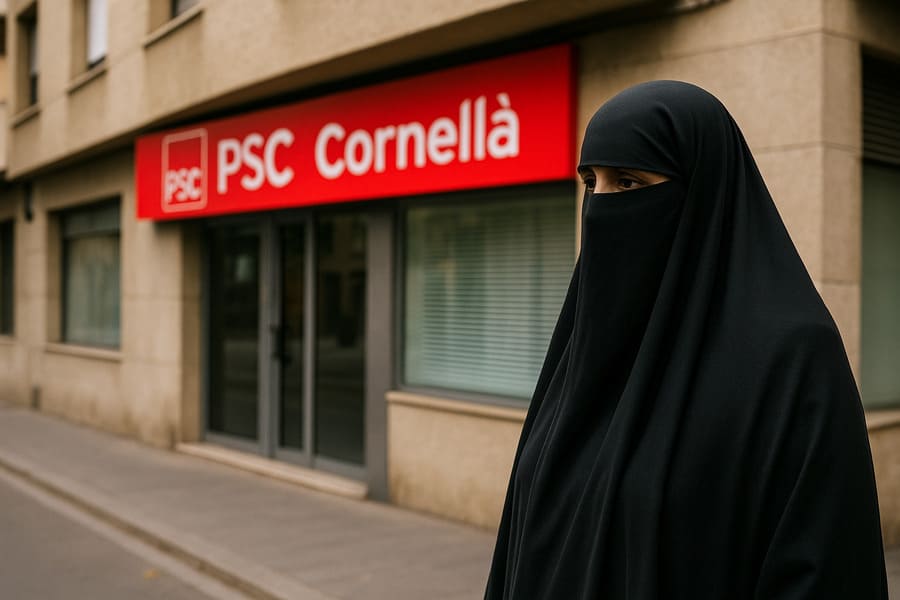
The radical jurist presented as a poet
Abū Bakr Muḥammad ibn al-Walīd al-Ṭurṭūšī was born in Andalusian Tortosa in 1059 and at the age of twenty set off on a journey to the East. He passed through Mecca, Baghdad, Damascus and Jerusalem before settling in Alexandria, where he developed his career as a jurist until his death in 1126. There is no mention in his biography of any connection with Tortosa or al-Andalus. nor with Europe beyond being born there. The only prominent political link with al-Andalus that is attributed to him is the religious support for the Almoravid emir Yūsuf ibn Tāshfīn to wage war on the Taifa kings., regarded as Muslim rulers who were misguided or insufficiently rigorous. Nor did they exert any influence on European thought as illustrious Andalusians such as Averroes, Maimonides or al-Zahrāwī (Abulcasis) did. In contrast, within the Muslim world He did, however, achieve prestige as a jurist and author of religious fatwas. of a line that does not fit with anti-racism.
Although the character's biography doesn't accompany, At the conferences he is presented as “a European thinker born in Tortosa” and as a key figure in demonstrating the Islamic roots of today's European society.. Moreover, the programme does not focus on his career as a jurist or on what his political and religious thought actually consisted of, which is precisely the field in which al-Turtuxī achieved prestige within the Islamic world.
The institutional portrait prefers to present him as a poet, thinker and Mediterranean sage unjustly hidden by structural racism. The Tortosa Town Council highlights its work. The Princes' Lantern as a handbook recommending “prudence, justice, equity, serenity and goodness”. The Directorate-General for Religious Affairs presents him as a “jurist, thinker, theologian and poet” and emphasises “public ethics”, “the organisation of collective life” and the “cultural exchanges” of medieval Mediterranean.
The result is a much friendlier al-Turtuxi than in his work devoted to social order and the position of non-Muslims. Presenting him as a poet plays a particularly useful role in this reconstruction of the character, but It is obvious that his poetry is a minor part of his legacy. and it brought him no prestige whatsoever. The poetry of al-Turtuxī exists, but it occupies a marginal place in medieval sources. Even The literary collections that preserve his verses present him first as “the jurist al-Turtuxí” and they highlight his work as a teacher of religious law. Indeed, a teaching resource from the XTEC network The Department of Education presents it as “one of the great references of our poetry”, despite acknowledging in the same sentence that his poetic output is irrelevant.
Christians must give their seat to Muslims.
The principal work of al-Turtuxí is the one highlighted by the General Directorate of Religious Affairs and the Tortosa City Council: The Princes' Lantern (Sirāj al-Mulūk). In this work, al-Turtushi sets out an ideal model of society in which Christians and Jews occupy a subordinate position to Muslims.. The text conveys specific rules governing how non-Muslims should dress, which religious symbols they may display, how they should build their temples and how they should behave in the presence of a Muslim. The key chapter is the 51, «On the rules concerning the people of the dhimma», available at the Arabic Collection Online of Columbia University. Among the conditions that al-Turtuxi sets out to regulate the lives of Christians and Jews under Muslim rule are:
- Christians and Jews must give way and give their seats to Muslims.
- Their houses cannot be higher than those of the Muslims.
- They cannot ride with a saddle or carry weapons like Muslims.
- They must dress in such a way that they are identifiable as non-Muslims.
- They cannot display crosses or other religious symbols.
- They cannot build or rebuild temples..
- They must not hold positions of authority over Muslims.
The religious difference thus becomes a legal, social and even visual difference. It is not just religious intolerance: It is a legal system of discrimination between people according to their faith., with social, political and public inferiority for Christians and Jews. The portrayal of the position of non-Muslims in a Muslim society is that of a community placed above the other in the public sphere.
Ultimately, The coexistence described by al-Turtuxí is not among equals nor does it fit with anti-racism: it is coexistence under subordination. He did not invent these rules, but he adopts them, makes them his own and incorporates them into his political work as part of the social order he considers legitimate and desirable.
The radical jurist behind the “Mediterranean sage”
Al-Turtuxí was not primarily a poet who longed for Tortosa as the institutional account describes. If he stood out, it was as a jurist of the Maliki school, the dominant Sunni legal tradition in al-Andalus and the Maghreb. Its task was precisely to to interpret Islamic law, resolve legal doubts and determine what was licit, illicit or a condemnable religious innovation.. This is very clear in The Book of Novelties and Innovations (Book of Innovations and Bidʿah) available at the Waqfeya library. In this work he examines daily and religious practices and judges them according to the Maliki tradition. Among the practices he censures or presents as condemnable innovations are:
- Condemns men and women mixing because it is a source of moral disorder.
- Restricts women's presence at funerals of parents, husbands, children or brothers.
- It prohibits music and dance in general, as well as those specific to Sufi spirituality. It does not treat them as a mere religious preference, but as deviant practices.
- Presents women as unreliable at keeping secrets. or as a negative influence on men.
- Prohibits cheeses made by Christians Europeans due to possible contamination with pork products.
- It prohibits Muslims and non-Muslims from sharing public toilets.
His fatwas show better than his poetry what his intellectual profession was. Al-Turtuxi could convert a matter as everyday as an imported European cheese in a legal, religious and political issue. And this opinion did not remain a debate among lawyers: it directly affected Alexandria's commercial and fiscal interests. The controversy escalated to the point that the authorities feared the economic impact of their rulings on trade, taxation and institutional authority. The government's response was to deport him from Alexandria and place him under house arrest in Cairo, away from his disciples and his public activities. This situation decisively contributed to turning al-Turtuxí into a well-known and controversial figure.
From the anti-racist day to the classrooms
Abu Bakr's political recovery of Tortosa culminates on 25 September with a Anti-Racist Day that It makes al-Turtuxí an explicit part of the contemporary discourse on Islamophobia, memory and diversity.. Dolors Bramon will speak there under the title “Abu Bakr al-Turtuxí: a European thinker born in Tortosa” and will explain why figures like his would have been “invisibilised”. Mostafà Shaimi will link directly “The Forgetting of al-Andalus” and contemporary Islamophobia, and the Director General of Religious Affairs, Ramon Bassas, will address the management of religious diversity in municipal, educational and healthcare settings. The programme does not hide its intention to use the character as a bridge between a particular interpretation of the past and current anti-racism and interculturality policies.
This reading will not be confined to adult lectures. The promoters of the Year of Abu Bakr have also announced Educational activities in schools and colleges in Tortosa and Roquetes. At present, there is no record that al-Turtuxí has been formally incorporated into the Catalan school curriculum, but there is a documented desire to bring his figure into the classroom. For years, educational materials in the Catalan educational environment have advocated a “decolonial vision of Literature” and they demand that education also incorporate the culture, history, folklore and literature of the places of origin of immigrant students.. The incorporation of al-Turtuxí would be a first step, as the document calls for. Interculturality and Literature of the Department of Education. The ideological need to find Muslim role models is so great that the document itself It even goes so far as to include as Andalusian poets from Lleida authors who never existed..
The commemoration of the 900th anniversary of the death of a controversial figure, little known outside academic circles and without any significant influence on European culture, goes far beyond a mere historical anniversary. Not even his connection to Tortosa and Europe goes beyond having been born there.. Despite this, al-Turtuxí is presented as a European thinker, a Catalan poet, a figure of diversity and an instrument to combat the form of racism known as Islamophobia.
This reinterpretation is not just local. The Generalitat actively participates in the construction and dissemination of this narrative. The Department of Culture supports the commemoration and the Directorate General of Religious Affairs sponsors the documentary. Abu Bakr of Tortosa. 900 years since his death. No prophet is honoured in his own land., which is also scheduled to be included in the Catalan Spiritual Film Showcase. The same Directorate General takes part in the Anti-Racism Day dedicated to the character.
The result is that a medieval jurist It has been reclaimed today as a proper cultural reference and as a pedagogical and anti-racist tool., while the more uncomfortable aspects of his legal and political thought remain hidden. And with al-Turtuxí we are not dealing with an inventor, a scientist, a philosopher or a great writer who left a decisive contribution to European culture: Abu Bakr did not improve anyone's life. He was, above all, a radical Islamic jurist, dedicated to Islamic law, concerned with regulating behaviour and dictating religious morality. The commemoration, therefore, is not limited to selling a friendly Abu Bakr, but serves to decide. what it represents today and what place it is to be given within the cultural narrative of Catalonia.
More about Catalonia

ERC, PSC and Comuns oppose combating political Islam in the European Parliament.
Lleida bans the burqa except if worn for religious reasons
Who is Fatiha El Mouali, much more than the helpless immigrant from the newspaper ARA
Transcription of Ramon Cotarelo's speech in Ripoll for the 2026 Diada
Barcelona City Council spends 44,000 euros to "learn about the Muslim practices we carry within"«
Islamic marriage in Catalonia requires a guardian to authorize the woman

ERC, PSC and Comuns oppose combating political Islam in the European Parliament.

Azerbaijan expels students who wear Islamic headscarves from school
Sharia law in the US is supported by 75% of Muslims, 41% of atheists and up to 20% of Christians.

France now has a halal meat supply without the need to sacrifice animals facing Mecca.

The United Kingdom gives away a thousand hijabs in six months to immigrants arriving via the Channel
US Muslim politicians train Canadian Muslims under the slogan "From the mosque to the city hall"«
Teacher fired in Austria for denying a Muslim woman a prayer room

Canadian government normalizes Islamic prayer during workday
Lleida bans the burqa except if worn for religious reasons
Italy bans burqa and niqab but only in schools

A student residence in Scotland imposes Islamic law in common areas
Kazakhstan threatens to close private schools that allow hijab
A Catholic university in Belgium incorporates Islamic chants into the opening mass of the course
A Muslim family in Granada chooses a Catholic school and demands that the courts teach Islam there
Convicted in Mallorca for gender violence for imposing the hijab, controlling and assaulting
Phrase of the Week

Image of the Week
-Don't you have cousins?