
An entity linked to the Muslim Brotherhood is conducting a survey to show that Catalan universities are not safe spaces for Muslims.
FEMYSO is a European Muslim youth federation repeatedly noted for its links to the Muslim Brotherhood. It has launched a survey to confirm that Catalan and European universities are hostile spaces for Muslim students.
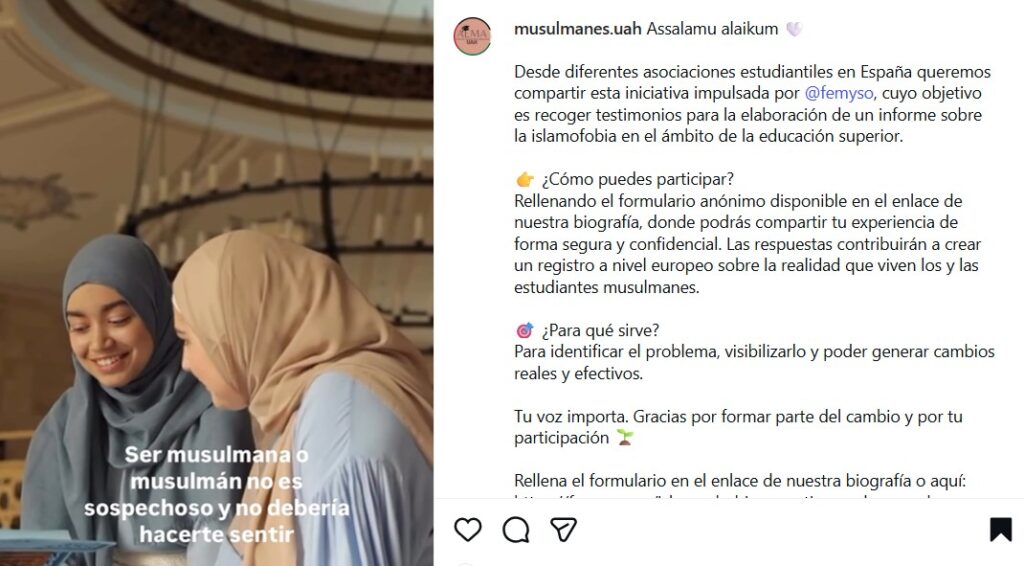
Image of the message disseminated by FEMYSO
[social-share align=»right» style=»button» mobile_app=»desktop»]
[social-share align=»center» style=»icon» mobile_app=»mobile»]
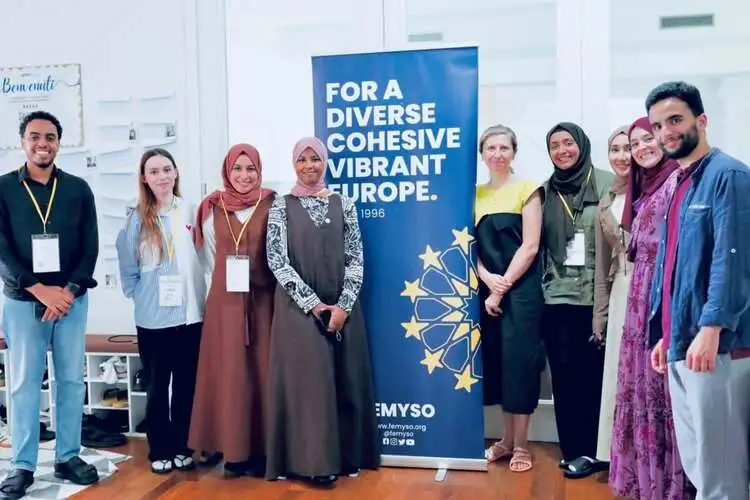
In recent days, it has appeared simultaneously on numerous social media profiles of young Muslims in Catalonia. A survey to assess Islamophobia in universities. The initiative is driven by the European Federation of Muslim Youth and Student Organisations (FEMYSO), a Brussels-based entity, and funded by unknown public and private sources. The organisation's main function is to produce reports, studies and policy recommendations for European institutions and education authorities.
The message accompanying the survey presents it as a tool to confirm the existence of an Islamophobia problem at the university and to justify the need for institutional interventions. The design and stated objective point to a predictable outcome: conclude that the university campus does not offer a safe and protective environment for Muslim students. Without even seeing the questions, one can already perceive that the survey's intention is To place the university institution under suspicion of mistreating Muslims from the very outset. This approach falls within a logic of systematic victimisation of Muslims in the West that transforms disagreement, institutional neutrality or the limits of secularism into forms of supposed oppression.
Questions aimed at confirming the narrative of structural Islamophobia
The questionnaire's bias lies not so much in who it is addressed to, but in how it frames the questions. The survey is based on the idea that The Muslim student already operates in a problematic environment. and builds the answers from this premise. The form poses a series of questions that They directly introduce a framework of persecution by non-Muslims.. From the outset, the participant is led to interpret their university experience as an environment of pressure, surveillance and identity conflict. The university does not appear as a plural space with diverse experiences, but rather as a potentially hostile setting where expressing oneself as a Muslim carries risks.

Muslims praying at UAB
He/she asks if the student has suffered an “Islamophobic incident” in the last five years, whether they have suffered censorship or sanctions for expressing opinions about Islam or whether they feel comfortable discussing topics related to Muslims on campus. The entire survey normalises serious concepts such as censorship, surveillance or repression as routine experiences for Muslims within the university. For example, They are asked if they feel their religious identity is “respected” by the institution., introducing a subjective criterion that turns any limit, disagreement or institutional neutrality into possible evidence of a lack of respect.
Do you think your religious identity is respected at your university?
☐ Yes
☐ No
Sometimes
The questionnaire delves into the construction of an adverse emotional climate, attributing feelings of fear, discomfort and self-censorship to the university institution. It directly asks how the university makes the student feel., directing the response towards a range of negative emotions that associate the campus with surveillance, denunciation and repression. This approach turns subjective experience into a political indicator and reinforces the idea that The malaise is structural and attributable to the very functioning of the institution..
How has your educational institution made you feel? (Select all options that apply)
Uncomfortable talking about topics related to Islam
☐ Afraid of being watched or reported
☐ Tick if you identify with a religious identity
☐ That I need to self-censor my opinions or beliefs
Safe and respected in expressing my beliefs
☐ No particular impact on how I feel or express myself.
☐ I'd rather not say
The survey also shifts the conflict to the academic arena, suggesting that The content of the studies can be problematic if it does not incorporate Islamic religious content.. The question of the representation of Islam in the curriculum is not posed as a matter of academic relevance, but rather… as a moral evaluation which pressures towards the idea that a lack of presence or critical treatment constitutes a form of grievance.
How would you rate the representation of Islam and Muslim perspectives in the curriculum of your educational institution?
☐ Well represented; no changes needed
☐ Somewhat represented, but there is room for improvement
☐ Little or no representation; urgent changes are needed
☐ Depicted negatively or inaccurately
☐ I'm not sure or I don't think it's relevant to my studies
☐ I'd rather not say
The university under pressure to accommodate Islam
The questionnaire sets the evaluation criteria. the university's ability to accommodate religious practices, turning this adaptation into an institutional support measure. In this way, any difficulty in reconciling academic requirements with religious obligations is presented as a shortcoming of the university system, rather than as a tension inherent in the coexistence between common norms and particular religious practices. For example, praying at university is presented as a necessity that the university must accommodate in terms of space and time.
How do you perceive your educational institution's support for Muslim students regarding their religious needs (prayer spaces, recognition of festivals, measures against Islamophobia, overall inclusion)?
Very supportive and respectful
☐ Generally supportive, but some improvements are needed
☐ Not sufficiently supportive or accommodating
☐ I'm not sure
Thus, the absence of dedicated prayer spaces or the failure to interrupt teaching activities during Islamic religious festivals are redefined as proof of Islamophobia. The secular and communal character of the public university disappears and religious demands are brought into the heart of academic functioning. In this logic, the religious freedom protected by law is not sufficient: The ordinary functioning of the university must be redefined to incorporate Muslim practices into its regular operations.. This insistence is neither incidental nor anecdotal. The centrality of prayer spaces and the reorganisation of academic time responds to one of the recurring obsessions of these ideological environments: to relocate religious practice into public and institutional spaces as a mechanism for normalisation and social control of Muslims. It's not just about rights, but about to make the university an extension of the religious order, with all the consequences this has for individual freedom and the secular character of the academic sphere.
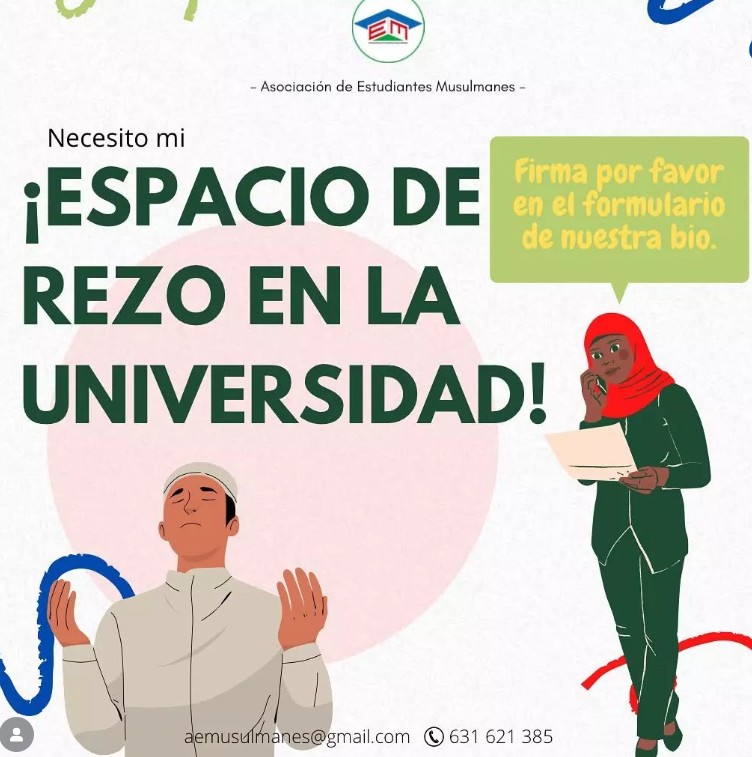
Campaign by students at the University of Barcelona to demand spaces for prayer.
The survey as a whole, its language and the demands it legitimises are part of a widely documented logic of the Muslim Brotherhood's orbit: using the discourse of rights, emotional security and inclusion to reconfigure secular institutions from within.
Islamophobia causing psychological harm and academic failure
In the final section of the questionnaire, the survey enters the realm of mental health in a particularly problematic way: turns Islamophobia into a universal explanation for any life inconvenience. Everything is absorbed into a single causal framework: If there is discomfort, academic blockage or professional difficulty, the cause is Islamophobia. structural of the system University student. Not as a hypothesis to be tested, but as an implicit conclusion that the survey asks to be confirmed.
When asked if the “Islamophobic” experience has had a psychological impact, “diagnosed or not”, The form eliminates any boundary between medicine, emotion and perception.. Subjective discomfort becomes sufficient proof, and The university is presented as a space that psychologically harms Muslim students. without the need for any clinical criteria. The survey closes the interpretative framework with a univocal attribution of the harm: eIn no case can the problem be Islam, religious practices or the ideology that accompanies them; the responsibility always and exclusively lies with the institution. which is blamed for the harm, being structurally hostile to Muslims.
Would you say that the islamophobic experience had an impact on your mental health, whether you were formally diagnosed or not?
☐ Yes
☐ No
The same mechanism extends to educational experience and life decisions. Fear of Islamophobia is offered as the pre-eminent explanation for the choice of studies, career path and access to internships or job opportunities. Any limit, renunciation or failure can be reinterpreted retrospectively as the consequence of a system designed to disadvantage Muslims.. Complexity disappears: there are no multiple factors, only a single, all-encompassing cause.
To what extent did the fear of confronting Islamophobia influence your academic or professional decisions?
☐ None
☐ Slightly
☐ Moderately
To a large extent
☐ I'd rather not say
Do you think that Islamophobia has affected your access to internships, networking opportunities or job prospects?
(If you answered yes, explain why.)
With this approach, the survey culminates a clear ideological operation: to shift all responsibility onto the institution and exonerate any critical examination of religious practices, discourses or demands. The university is always portrayed as the culprit, never as a space of shared norms or as a legitimate framework for conflict and demands. Psychological distress, academic failure and professional difficulties cease to be complex realities and become automatic proofs of oppression.
This logic does not seek to understand or resolve real problems, but to build. a permanent narrative of grievance that legitimises political pressure, the identity reconfiguration of the university and the imposition of confessional adaptations. In the end, it is not coexistence that is reinforced, but rather a vision according to which It's always the others who have to change..
FEMYSO and the orbit of the Muslim Brothers
The narrative constructed by this survey does not appear in a vacuum nor is it the result of an improvised initiative. It fits perfectly within the ideological framework of the orbit of the Muslim Brotherhood, with whom FEMYSO It has been repeatedly pointed out for its personal, discursive and strategic links.
The strategy is always to use. the fight against “Islamophobia” as a lever to pressure institutions and redefine the concept of religious freedom. The French Ministry of the Interior was made public in May 2025 a report on political Islamism that places FEMYSO within the ecosystem of the Muslim Brotherhood. Describe the organisation as a youth structure linked to pan-European networks, with a training and institutional projection function.
The ideological proximity between FEMYSO and the Muslim Brotherhood is reflected in the shared spaces, people and projects. For example, in 2011, a Council of Europe report on Islamophobia, prepared with the participation of actors linked to FEMYSO, including the contribution of Tariq Ramadan, a Swiss theologian and grandson of the founder of the Muslim Brotherhood. Without crediting an organic dependency, This coincidence illustrates the intellectual framework within which certain initiatives have operated.the same language, the same priorities and an expansive conception of religious freedom that pressures secular institutions to adapt to it.
A key figure of FEMYSO is Intissar Kherigi, who held management responsibilities within FEMYSO and is daughter of Rached Ghannouchi, former leader of the Tunisian Islamist party Ennahdha, widely described as a movement inspired by the tradition of the Muslim Brotherhood. This kinship is not an accusation in itself, but It has been explicitly cited in political debates and European documents. as a relevant element for contextualising FEMYSO's ideological environment.
The logic of the relationship between FEMYSO and the ideology of the Muslim Brotherhood is also seen in controversies such as The Council of Europe campaign that linked “freedom” and “hijab”, withdrawn after the political reaction in France. The campaign was criticised because it was part of inclusion and anti-discrimination programmes, but It was really the promotion of a specific religious symbol..
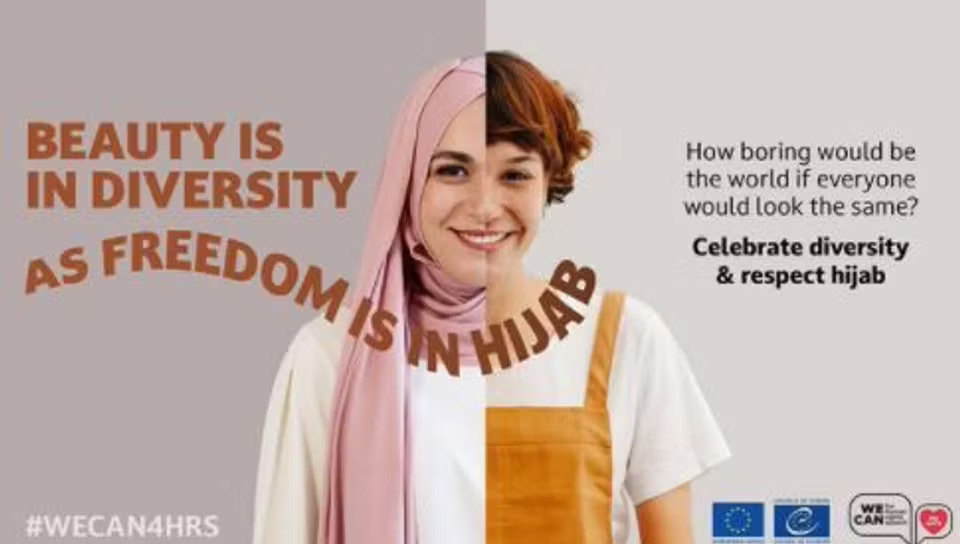
FEMYSO campaign in favour of the veil, funded by the EU.
FEMYSO has repeatedly denied any structural or ideological link with the Brotherhood and has denounced smear campaigns. However, the profile of leaders such as Kherigi, shared projects and institutional recognition explain why governments and official reports place FEMYSO within a ideological continuity that uses the anti-discrimination discourse to to have a political impact about universities and European institutions.
In Catalonia, this ideological framework does not operate in an abstract way, but through a network of Muslim student associations that have coordinated the distribution of the survey on social media. Profiles linked to Muslim youth collectives at UAB, the University of Girona, the University of Barcelona and other campuses across the country have echoed the same message, the same link and the same language., presenting the initiative as a collective action of the student body. This local capillary action is key: it allows a discourse elaborated in Brussels to permeate the Catalan university landscape with an appearance of spontaneity and representativeness., turning campus associations into transmission belts of a broader political agenda.
More Perceptions of
More about Muslim Brotherhood

The United Kingdom gives away a thousand hijabs in six months to immigrants arriving via the Channel
A student residence in Scotland imposes Islamic law in common areas
Scottish independence removes flags from Scotland so as not to inconvenience immigrants
Muslim school that forces hijab on 7-year-old girls moves to UK public system
UK detects Muslim gangs forcing prisoners to convert to Islam to survive
Convicted in the United Kingdom for a joke about Islam on social media.
British Islamism is already talking about training Muslims in martial arts in mosques.
A report on rape gangs in the United Kingdom links Islam with violence and the state's inaction.
The Welsh police will record comments it considers “hostile” towards Islam.

ERC, PSC and Comuns oppose combating political Islam in the European Parliament.
Azerbaijan expels students who wear Islamic headscarves from school
Sharia law in the US is supported by 75% of Muslims, 41% of atheists and up to 20% of Christians.

France now has a halal meat supply without the need to sacrifice animals facing Mecca.
The United Kingdom gives away a thousand hijabs in six months to immigrants arriving via the Channel
US Muslim politicians train Canadian Muslims under the slogan "From the mosque to the city hall"«
Teacher fired in Austria for denying a Muslim woman a prayer room
Canadian government normalizes Islamic prayer during workday
Lleida bans the burqa except if worn for religious reasons
Italy bans burqa and niqab but only in schools
The Generalitat pays tribute to the racist Abu Bakr al-Turtuxí as an anti-racist icon
A student residence in Scotland imposes Islamic law in common areas
Kazakhstan threatens to close private schools that allow hijab
A Catholic university in Belgium incorporates Islamic chants into the opening mass of the course
A Muslim family in Granada chooses a Catholic school and demands that the courts teach Islam there
Phrase of the Week

Image of the Week
-Don't you have cousins?