
TikTok spreads emotional Salafism among girls with the message: ‘I'm happy with my veil’
TikTok has become a genuine digital Salafist mosque that spreads a discourse of submission and religious identity among teenagers.
Illustrative image
Generated by AI
[social-share align=»right» style=»button» mobile_app=»desktop»]
[social-share align=»center» style=»icon» mobile_app=»mobile»]
To get in touch with Salafism today you don't need to read the Qur'an or set foot in a mosque. All you have to do is open TikTok and watch a video. The screen shows A young, friendly girl, wearing a hijab or niqab, says with a warm smile: “Since I started wearing the veil, I've been happy.”. This message is repeated, with variations: “”I feel free in the hijab,“ ”Wearing the veil has freed me,“ ”Now I know who I am.".
According to the HateScape report from the Institute for Strategic Dialogue (ISD), a 24-year-old from the extremist content detected on TikTok uses highly appealing emotional and visual formats for adolescents. Radicalisation does not begin with a message of hate, but with a message of love—to God, to religious law, to a closed community (ISD, 2021).
The content does not seem dangerous. There are no weapons, nor calls to fight. But Behind this appearance of inner peace lies a soft, emotional Salafist discourse that appeals to teenage girls with no religious training.. A discourse that associates the female happiness in submission, to differentiation from the West, and to a rigorist vision of Islam.
The veil as happiness and protection
The central message is simple: The veil is not oppression, but freedom.. These Muslim influencers—often young, charismatic and modern— They present the hijab as an act of love for God, as protective armour against the outside world.. They say that in the past they lived lost, exposed, oppressed by capitalism or the male gaze. And that now, covered and obedient, they feel “full”. They use phrases such as:
- “I am a pearl, and pearls protect themselves.”
- “I am not a slave of men, I am a slave of Allah.”
- “With the veil on, they no longer look at me as a body, but as a soul.”
- “I don't need society's approval, only Allah's.”
- “I have been stronger since I have been living according to God's will.”
- “I used to want to please others. Now I only want to please Allah.”
- “Covering up doesn't make me weak, it makes me powerful.”
- “Western women think they are free, but they are slaves of the system.”
These words function as an emotional hook. They take the form of advice, but they act as an ideology.. What they present as a personal choice is, in reality, a closed model of a virtuous and pure woman, the opposite of the Western one., which is shown as lost, empty or corrupted.
This language directly appeals to adolescents seeking identity or community. In fact, a report from the RAN (Radicalisation Awareness Network) maintains that Young people are vulnerable to these messages because many experience discrimination or a lack of belonging. and seek connection through a female figure who speaks like them
TikTok as a Salafist mosque
This phenomenon doesn't happen inside mosques, but in the pocket. Today, TikTok is a digital Salafist mosque: a space for preaching, community and identity formation. And the algorithm acts as a minaret. If a user watches or interacts with a single video on female religiosity, within a few days she will receive an avalanche of similar content: messages of obedience, renunciation, devotion, purity.
The women who spread this message They do not fit the old stereotype of the submissive and invisible Islamic woman.. On the contrary: sThey are modern young people, they take care of their appearance, they speak with confidence., They have thousands of followers and present themselves as examples of success. They wear a hijab or niqab, yes, but They also wear well-coordinated modest fashion clothes, apply subtle make-up, and use trendy filters and music.. They know TikTok's visual language and use it to their advantage. They laugh, make tutorials, show confidence. And all of this reinforces the idea that wearing a veil is not only “correct”, but also attractive, empowering and aspirational.
Influencers lifestyle as emotional preachers
These women They do not need formal religious training to exercise symbolic authority.. Publishing short videos with spiritual recommendations, a gentle aesthetic and direct speech: “You can feel as good as I do too.”This creates communities of adolescents seeking belonging and guidance, often in place of mosques or traditional networks.
The investigation Muslim TikTok in Germany confirms that these influencers serve as emotional and identity guides, especially among European girls with no deep religious contact or formal community structure.
Similar

Azerbaijan expels students who wear Islamic headscarves from school
The United Kingdom gives away a thousand hijabs in six months to immigrants arriving via the Channel
Lleida bans the burqa except if worn for religious reasons
Italy bans burqa and niqab but only in schools
Kazakhstan threatens to close private schools that allow hijab
Convicted in Mallorca for gender violence for imposing the hijab, controlling and assaulting
Muslim teacher in Flanders prefers unemployment to taking off her hijab
Even Kadyrov's Islamized Chechnya doesn't want women with their faces covered with the niqab
Feminist strike in Austria to defend the Islamic veil for children under 14

More Perceptions of
ERC, PSC and Comuns oppose combating political Islam in the European Parliament.
Azerbaijan expels students who wear Islamic headscarves from school

Sharia law in the US is supported by 75% of Muslims, 41% of atheists and up to 20% of Christians.
France now has a halal meat supply without the need to sacrifice animals facing Mecca.

The United Kingdom gives away a thousand hijabs in six months to immigrants arriving via the Channel
US Muslim politicians train Canadian Muslims under the slogan "From the mosque to the city hall"«
Teacher fired in Austria for denying a Muslim woman a prayer room
Canadian government normalizes Islamic prayer during workday
Lleida bans the burqa except if worn for religious reasons
Italy bans burqa and niqab but only in schools
The Generalitat pays tribute to the racist Abu Bakr al-Turtuxí as an anti-racist icon
A student residence in Scotland imposes Islamic law in common areas
Kazakhstan threatens to close private schools that allow hijab

A Catholic university in Belgium incorporates Islamic chants into the opening mass of the course
A Muslim family in Granada chooses a Catholic school and demands that the courts teach Islam there
Phrase of the Week

Image of the Week
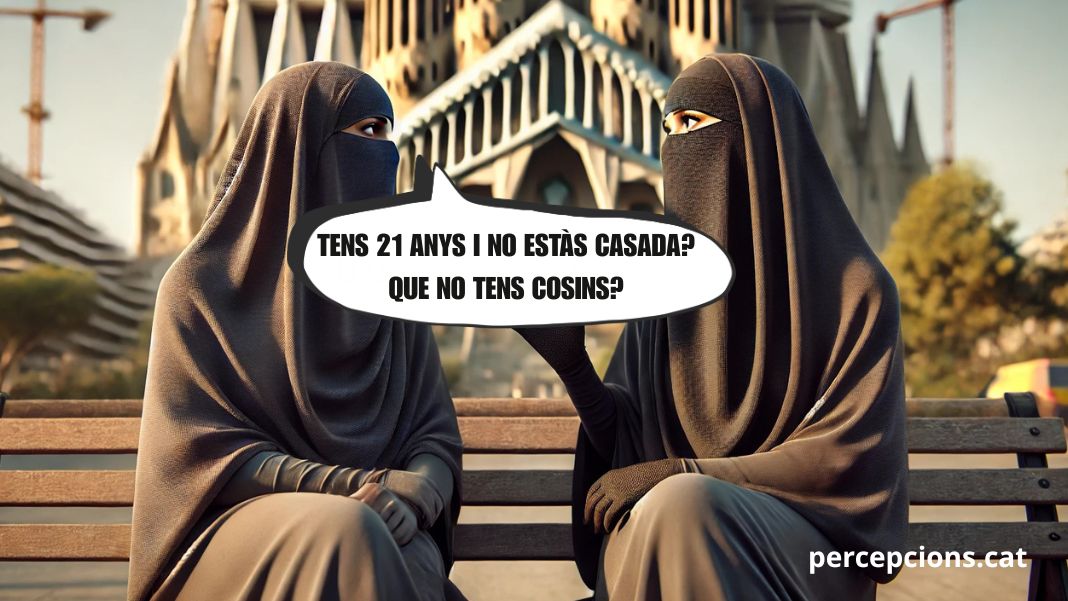
-Don't you have cousins?