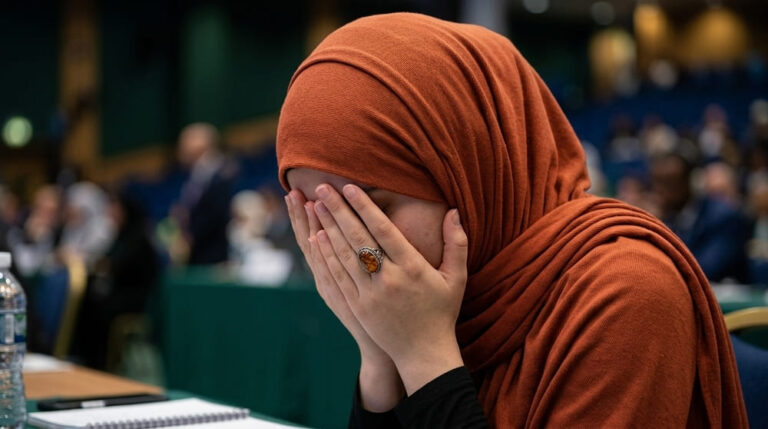
Seyran Ateş is the founder and imam of the Ibn Rushd-Goethe Mosque in Berlin. Her defence of a liberal Islam and her open criticism of religious radicalism have made her a figure loathed by large sections of the German Muslim community. She has returned to the centre of controversy by telling Euronews that there are «a plan to cause unrest, recruit followers and advance the project of Islamising Europe«
She made these statements in relation to the demonstrations by Muslims in Berlin to celebrate the massacres of Druze and Christians in Syria. According to her, these and other mobilisations They are part of a broader strategy to impose a religious ideology incompatible with democratic values.. It is argued that these actions are not mere expressions of protest, but a real threat to democratic coexistence.
The risk of tolerating fanaticism
Ateş does not question the right to demonstrate or freedom of expression as a fundamental pillar of any democratic society. However, he warns that Tolerance cannot become an open door to fanaticism., nor be used as a shield to protect discourses that aim to destroy the very system that allows them to exist.
According to her, Germany is and must remain a liberal society, open to debate and to a plurality of ideas, even the most controversial. But she insists that there are limits that cannot be ignored.“A liberal society like Germany cannot and will not shut itself off from radical opinions, as long as they do not threaten the constitution.”, he says.“But these groups do threaten him.”With these words, Ateş makes it clear that, in his opinion, The State and civil society cannot continue to turn a blind eye to the spread of a radicalism that uses religious language. to infiltrate public spaces with clearly destabilising intentions.
Widespread rejection of the German Muslim community
Ateş's words have generated strong backlash within significant sectors of the Muslim community in Germany. Several imams and religious leaders have criticised her attitude, accusing her of generalising and criminalising the entire community for the actions of a minority.. They believe that their discourse fuels the stigmatisation of Muslims and reinforces Islamophobic narratives.
Some, such as Imam Benjamin Idriz of Bavaria, They have argued that the vast majority of German Muslims reject fanaticism and live peacefully with democratic values. According to these voices, Ateş confuses Islam with Islamism and creates an unjust division within an already stigmatised community. Idriz Condemns the use of the term "Islamisation" and says it is Islamophobia. because it generates more hatred than solutions. .
A life under police custody for being Muslim
Despite the criticism and threats, Ateş remains firm. According to her, This is not a critique of religion, but of a totalitarian ideology that masquerades as faith.. And he insists that remaining silent for fear of being misunderstood only benefits those who wish to impose silence and dogma.
Seyran Ateş was born in Istanbul in 1963 into a family of Turkish and Kurdish origin, and moved to Berlin with her family when she was young. From a very early age She became involved in defending the rights of Muslim women., especially those subjected to forced marriages, domestic violence or community pressure.
She studied law and specialised in cases related to gender-based violence and human rights. As early as the 1980s, she began receiving threats from radical Islamist groups, and in 1984 she was the target of an armed attack at a women's advice centre. Since then, she has lived under permanent police protection.
Apostate to found a feminist and LGTBI mosque
In 2017, he founded the Ibn Rushd-Goethe Mosque in Berlin, the first liberal mosque in Germany., Open to men and women alike, where segregation by sex is rejected and where LGTBI people are also given a voice.. This groundbreaking move has generated admiration and hatred in equal measure: while some regard it as a necessary pioneer, others… They label her a traitor and an apostate..
Ateş represents a unique figure: A woman, a Muslim imam, who not only questions fundamentalisms but also the silences and complicities within and outside the community.. And he does so every day, with a conviction that forces him to live with a bodyguard.