
The EU finances reports that accuse Catalonia of Islamophobia with authors linked to the Muslim Brotherhood
The European Islamophobia Report presented on December 19th compiles situations that its authors use to accuse Europe of structural Islamophobia. Catalonia is portrayed as an Islamophobic country.
[social-share align=»right» style=»button» mobile_app=»desktop»]
[social-share align=»center» style=»icon» mobile_app=»mobile»]
The European Islamophobia Report is an annual publication that analyses the evolution of what its editors define as Islamophobia in European states. The project was launched in 2015 and has since published successive editions with a similar structure: an extensive volume with country chapters prepared by local researchers documenting situations related to Muslims or Islam. The project's editors interpret this collection of situations as evidence of systemic and pervasive discrimination against Muslims.
The report does not function as an official register of hate crimes nor as a police statistic. The authors select cases according to their own criteria and integrate them into a common interpretative framework. This approach allows the inclusion of both assaults or insults and legislative debates or political positions. The document It does not strictly distinguish between violence, discrimination, critical ideological dissent or political disagreement..
The editors' links with the Muslim Brotherhood's milieu.
The debate over the European Islamophobia Report has also focused on one of its editors, Farid Hafez. In November 2020, The Austrian police searched his home as part of an operation against possible networks linked to the Muslim Brotherhood in the country.. In January 2023, an Austrian court dismissed the case for lack of evidence. Hafez has always denied any illegal activity. Nevertheless, these events have helped place his profile at the centre of the political and institutional debate surrounding the report.
Hafez not only gained public notoriety following the 2020 police registration but also for his previous associational background. Several sources indicate that Hafez is listed as a founding member of the Muslimische Jugend Österreich, a Muslim youth organisation active in Austria. Various analytical reports on political Islam in Europe have placed this entity within the ideological orbit of the Muslim Brotherhood in the country..
Turkey's role in the report
The other lead editor of the European Islamophobia Report is Enes Bayrakli, a Turkish academic specialising in international relations and European studies. Bayrakli has spent much of his professional career at the SETA Foundation., an analysis centre based in Ankara that numerous analysts and European governments consider to be close to the Turkish government. Within this foundation, it promotes activities and publications aimed at denouncing what it describes as growing Islamophobia on the European continent.
This trajectory is significant because Erdogan's government has repeatedly used the narrative of European Islamophobia as a political and diplomatic tool. Various Turkish officials have cited data and conclusions from the European Islamophobia Report in public events and international forums to reinforce the idea that Europe maintains a structurally hostile attitude towards Islam. Enes Bayrakli's involvement in this project has fuelled debate about the extent to which the report maintains a genuine distance from the Turkish political agenda.

Catalonia as a central space in the narrative of the report
The European Islamophobia Report It grants Catalonia a significant role within the chapter dedicated to Spain and repeatedly presents it as one of the main settings for conflicts related to Islam and the Muslim presence.. The authors position the territory as a space where municipal and social political debates converge, which, in their interpretation, reflect an entrenched and normalised Islamophobia. This specific focus does not so much reflect a higher documented incidence of assaults as the public visibility of certain local conflicts and administrative decisions.
The report compiles various incidents that have occurred in Catalan municipalities concerning the opening or regulation of oratories and mosques, with neighbourhood controversies or local government positions. The authors integrate these cases into a single interpretative framework and present them as examples of structural discrimination., without distinguishing between local opposition, urban planning debate, the application of municipal regulations or explicit rejection on religious grounds. This approach allows local management conflicts to be turned into indicators of a general ideological problem.
The document also places special emphasis on the debate over the use of the Islamic veil in the educational sphere and in other public spaces in Catalonia.. The authors describe any discussion of regulation or limits as an expression of institutional Islamophobia., without analysing in depth the Catalan legal framework or the tradition of secularism that underpins much of these debates. The report does not address the diversity of opinions existing either within Catalan society or among Muslims.
Edition after edition, Europe is Islamophobic.
The European Islamophobia Report maintains the same underlying conclusion in every edition: Europe is a structurally Islamophobic space. The project's editors repeat this diagnosis in from an accumulation of heterogeneous cases that include real assaults, administrative decisions, political debates and local social conflicts. The report does not reformulate the interpretative framework or introduce new criteria that would allow for testing or qualifying this thesis, but rather rIt reaffirms year after year a global reading that presents the continent as a problem. and places the European institutions under permanent accusation.
This continuity is also reflected in the project's formal evolution. After the criticisms over European funding and its links with the SETA Foundation, The report changed its logo and imprint, but retained the same editors, methodology and narrative.. The project replaced one public image with another without altering its content or direction. This seemingly secondary detail encapsulates the nature of the European Islamophobia Report, a report that changes its presentation but keeps its central thesis intact. Nevertheless, the report continues to circulate in European institutional, academic and political circles as a reference in the debate on Islamophobia.
More Perceptions of
More about Muslim Brotherhood

ERC, PSC and Comuns oppose combating political Islam in the European Parliament.
Who is Fatiha El Mouali, much more than the helpless immigrant from the newspaper ARA
Austria prepares to ban Muslim Brotherhood political Islam
Germany prevents civil servant from being a civil servant due to ties with the Muslim Brotherhood
An official Austrian report accuses the Muslim Brotherhood of wanting to transform democracy from within.
The foundation that manages the Barcelona Office of Religious Affairs paid €175 to denounce Islamophobia
The Generalitat trains teachers with an Islamic preacher who denies Western equality between men and women
The University of Strasbourg paid the lawyers of a student who had denounced a researcher critical of the Muslim Brotherhood.
Germany's intelligence service warns of the infiltration of the Muslim Brotherhood into institutions and parties.

ERC, PSC and Comuns oppose combating political Islam in the European Parliament.
Azerbaijan expels students who wear Islamic headscarves from school

Sharia law in the US is supported by 75% of Muslims, 41% of atheists and up to 20% of Christians.

France now has a halal meat supply without the need to sacrifice animals facing Mecca.
The United Kingdom gives away a thousand hijabs in six months to immigrants arriving via the Channel
US Muslim politicians train Canadian Muslims under the slogan "From the mosque to the city hall"«
Teacher fired in Austria for denying a Muslim woman a prayer room
Canadian government normalizes Islamic prayer during workday
Lleida bans the burqa except if worn for religious reasons
Italy bans burqa and niqab but only in schools
The Generalitat pays tribute to the racist Abu Bakr al-Turtuxí as an anti-racist icon
A student residence in Scotland imposes Islamic law in common areas
Kazakhstan threatens to close private schools that allow hijab
A Catholic university in Belgium incorporates Islamic chants into the opening mass of the course
A Muslim family in Granada chooses a Catholic school and demands that the courts teach Islam there
Phrase of the Week

Image of the Week
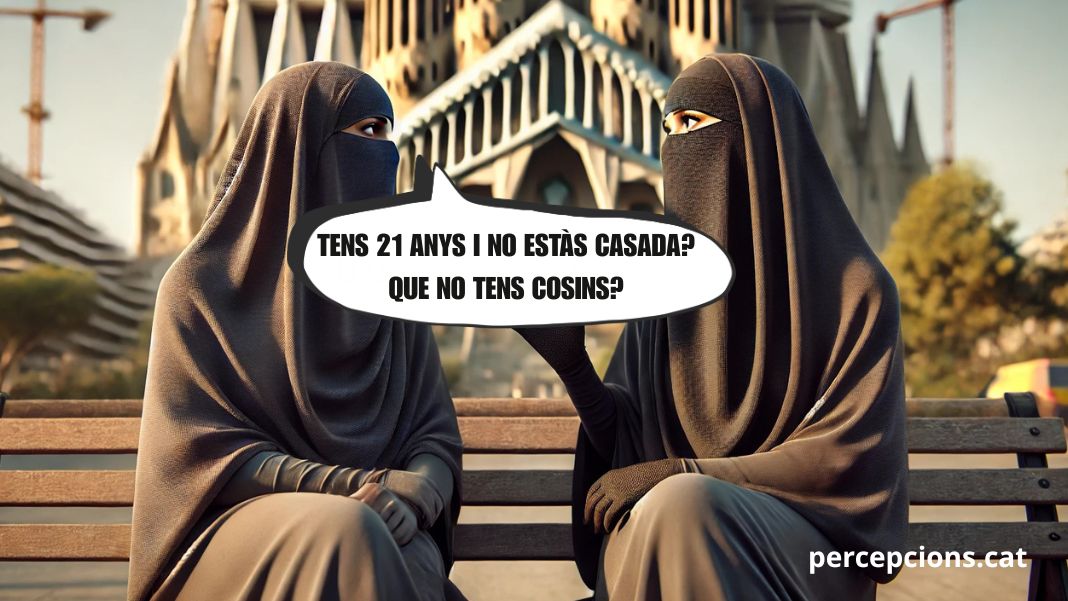
-Don't you have cousins?