
Germany can no longer afford the security for Christmas markets
The Christmas markets in Hamburg-Rahlstedt, Overath and Rostock, and dozens of small villages, are closing for good. They cannot afford the cost of protecting themselves from Islamists.
Illustrative image
Generated by AI
[social-share align=»right» style=»button» mobile_app=»desktop»]
[social-share align=»center» style=»icon» mobile_app=»mobile»]
German Christmas culture is collapsing. Every year more markets close for lack of funds, and the main reason is not a shortage of visitors: it is the cost of security. After the 2016 Berlin attack, and especially after the 20 December 2024 Magdeburg attack, security regulations have been tightened: fences, concrete bollards, controlled access and intensive surveillance. But many organisers, especially in small municipalities, cannot afford these expenses.
The Rahlstedt Christmas market has closed for good after years of constant losses; in Overath the town council has ruled out reopening it because security costs had already exceeded the budget. Many towns in Saxony, North Rhine-Westphalia and Mecklenburg have been forced to cancel or scale back their markets due to a lack of volunteers, resources and, above all, because The councils do not want to assume the risk..
20.1 per cent of the revenue goes to security.
Costs have soared across the country. According to the portal Municipal.de, Security costs for a medium-sized market have quadrupled in a decade.. In Dresden, the Striezelmarkt — one of the oldest in Europe — allocates nearly €4 million solely to security, according to municipal data. In Magdeburg, the organisers estimate that One in every five euros of income goes towards protective measures., including access blockades, police surveillance and additional insurance.
The newspaper Focus A Hannover police official is quoted as saying: “Small markets cannot afford what is now legally required.". The minimum security costs easily exceed €80,000., even if there are only a few stalls.” The former Interior Minister of North Rhine-Westphalia, Ralf Jäger, sums it up: “We cannot protect every event under maximum-risk criteria. If we carry on like this, The small markets will disappear and only the big ones will remain., commercial and impersonal.”
The major tourist markets survive thanks to volume and sponsorship, but the neighbourhood and parish ones are giving up.Where there were once stalls and mulled wine, today there are metal fences and silence.. Germany is facing an uncomfortable reality: it cannot afford the security of its own most popular tradition.
The terrorists have won
The cancellation of Christmas markets is an acknowledgement that terrorists have achieved their objective. But the problem goes beyond that and affects all kinds of mass gatherings. The Kessenich Autumn Festival in Bonn, He stated that it had had to close due to the “inability to implement a viable security concept that meets current requirements.”. Now, the situation in Germany is that any event involving a large number of people requires extraordinary security measures that someone has to pay for. The organisers are calling on the state to cover the costs, but it does not.
Thus, fear and mistrust have become an added cost of public life, a bill that no one wants to foot but that shapes every collective celebration.
More about Germany

Imam in Germany: "Every Muslim knows another who votes for the AfD"«
Germany prevents civil servant from being a civil servant due to ties with the Muslim Brotherhood
Forty-one per cent of Muslim students in Berlin want the precepts of the Qur'an taught in class.
German police investigate kindergarten cook for serving pork to Muslims

ERC, PSC and Comuns oppose combating political Islam in the European Parliament.
Azerbaijan expels students who wear Islamic headscarves from school
Sharia law in the US is supported by 75% of Muslims, 41% of atheists and up to 20% of Christians.

France now has a halal meat supply without the need to sacrifice animals facing Mecca.
The United Kingdom gives away a thousand hijabs in six months to immigrants arriving via the Channel
US Muslim politicians train Canadian Muslims under the slogan "From the mosque to the city hall"«
Teacher fired in Austria for denying a Muslim woman a prayer room
Canadian government normalizes Islamic prayer during workday
Lleida bans the burqa except if worn for religious reasons
Italy bans burqa and niqab but only in schools

The Generalitat pays tribute to the racist Abu Bakr al-Turtuxí as an anti-racist icon
A student residence in Scotland imposes Islamic law in common areas
Kazakhstan threatens to close private schools that allow hijab
A Catholic university in Belgium incorporates Islamic chants into the opening mass of the course
A Muslim family in Granada chooses a Catholic school and demands that the courts teach Islam there
Phrase of the Week

Image of the Week
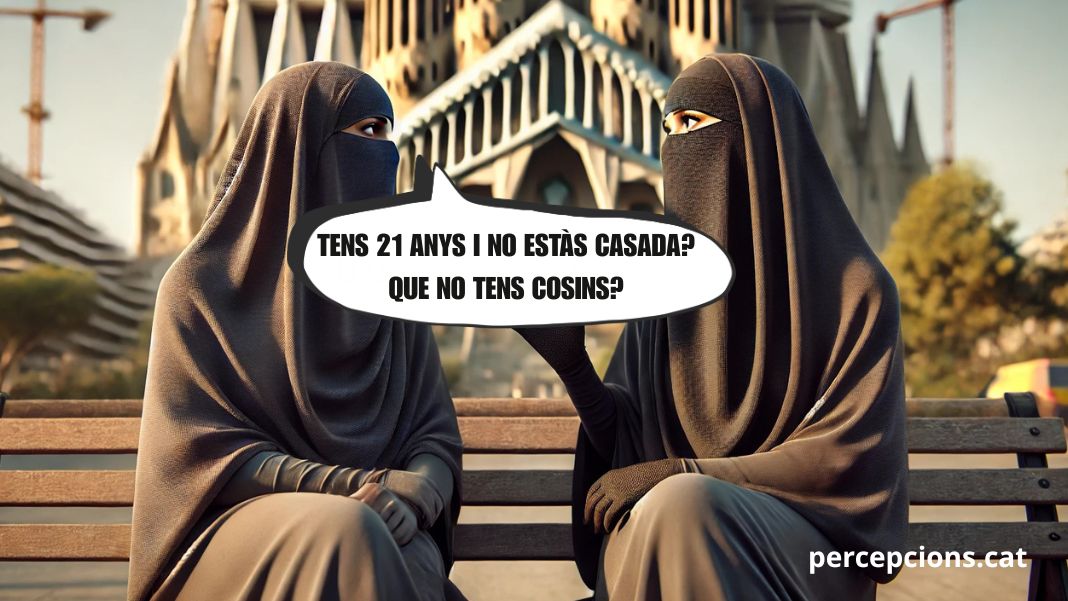
-Don't you have cousins?