
A Salafist center in Barcelona educates girls according to the values of 7th century Islam
Girls and women are brought up to be role models of Islamic behaviour. The centre belongs to a network linked to the Pakistani institution Dawat-e-Islami, active throughout Europe.
Sign at the Salafist centre on Paral·lel in Barcelona
Perceptions.cat
[social-share align=»right» style=»button» mobile_app=»desktop»]
[social-share align=»center» style=»icon» mobile_app=»mobile»]
In an apparently discreet premises in Barcelona's Paral·lel district Operates a centre offering extracurricular religious education for girls and women only.. Its name, «Faizan e Sahabiyat», It refers to the first female followers of the Prophet Muhammad.. The space operates outside the Catalan education system and is not subject to any form of official inspection. Despite this, its activities are regular, structured and have a clear educational focus.
The teaching provided there does not include mathematics, science or languages. The centre transmits doctrines based on female submission, extreme modesty, obedience to the husband and rejection of Western culture.. Girls are taught there to dress in clothing that completely covers their bodies, to speak in a low voice, to avoid contact with boys and to regard the home and family as their sole life purpose. The female figure is presented as the spiritual pillar of the Islamic patriarchal system.

Dawat-e-Islami is the Salafist organisation that educates girls in Barcelona.
The Paral·lel centre is part of the international network of Dawat-e-Islami, an Islamic movement founded in Pakistan in 1981 and now present in 190 countries. In Catalonia they have six mosques: three in Barcelona, one in Badalona, one in Amposta and one in Tortosa.
The organisation defines itself as non-political and dedicated to the propagation of the Qur'an and the Sunnah, but its doctrinal discourse and educational practices fall within the Salafist current. The Salafism is a rigorist interpretation of Sunni Islam that promotes a return to the religious and social practices of the seventh century., the era of the Prophet Muhammad and his first followers. Among the core values regarding women that the Salafist organisation states unabashedly on its website are:
- She must cover her entire body with Islamic clothing (hijab or niqab).
- She cannot leave the house without a justified reason, only for household chores or to support her husband.
- She cannot speak with men who are not immediate family.mahram) because it can lead to «disastrous consequences for society». Even worse if men are unfaithful, as it is considered a direct threat to the morals and faith of the Muslim woman.
- She cannot work outside without her husband's permission.
- She must be submissive, modest, shy, discreet and always maintain her dignity and chastity: if a man looks at her by accident, she should immediately lower her gaze and repent.
- Mixed social relations are prohibited, including conversations, calls, contacts via social media or any unsupervised interaction.
- They cannot celebrate birthdays or take part in Western customs.
- Education should be based solely on traditional Islamic values, avoiding educational systems based on secular Western values.
- One must keep one's heart free from envy or resentment.
The explicit objective of Dawat-e-Islami is to train «Muslim women with deep religious knowledge and exemplary character». The Muslim woman must follow the traditional female models of early Islam, such as Khadijah, ‘Aaishah and Fatima, as they are examples of purity, scholarship, sacrifice and submission to the religious framework.
The education that girls receive at this centre aims to instil these values from childhood., with a vision that excludes gender equality, personal freedom or economic autonomy. The entire educational system is geared towards constructing a female identity that is subordinate, discreet and devoted to family and religion.
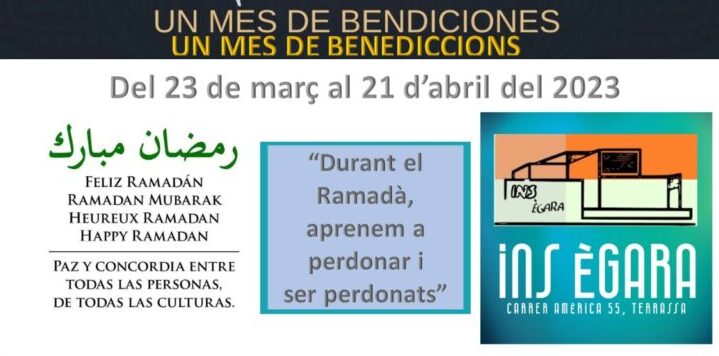
Salafist extracurricular activity without institutional oversight
Despite its ideological influence and constant presence, the centre is not part of the regulated education system. It operates as a cultural or religious association, which keeps it outside the oversight mechanisms of the Generalitat or the Barcelona City Council.. No inspection oversees the content taught there or the teaching methods used.
The activity takes place outside school hours: in the afternoons, at weekends or during special periods such as Ramadan. According to community sources, Some families take their daughters there several times a week.. The centre has signs, female teaching staff assigned, segregated spaces and its own materials. Everything is geared towards conveying. a way of life that excludes integration with the host society.
And where are the children and the men?
In many rigorist interpretations of Islam, women's participation in mosques is limited or directly discouraged on the grounds that they have “the privilege” of praying at home and of not assuming the communal duties reserved for men. In these currents, it is the man who typically receives the religious instruction and passes it on to the rest of the family.
Some currents more sensitive to women's demands have set up women's spaces inside mosques: in Catalonia they are always small, separate, out of sight and with their own entrances, conceived more as a concession than as a full-rights recognition.
Dawat-e-Islami follows a conservative line and is not characterised by promoting the presence of women in religious spaces. For this reason, in their mosques men and boys have spaces for prayer, study and participation in community activities—such as processions celebrating the Prophet's birth—while women remain largely outside formal community life.
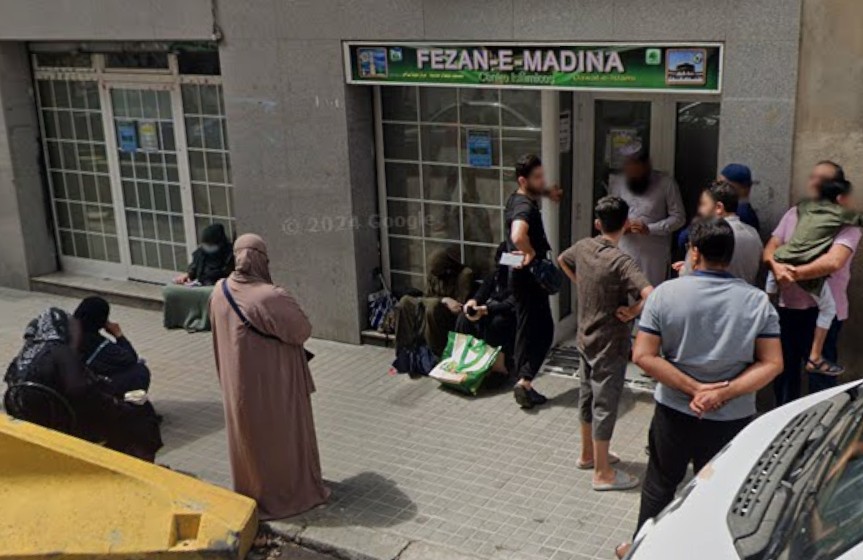
Men and women dressed according to Islamic law waiting for the children at the Dawat-e-Islami mosque in Poblesec.
Dawat-e-Islami are the champions of the fight against blasphemy.
Dawat-e-Islami is one of the movements that most actively fuel and export the idea that Defending the Prophet's honour is an absolute obligation.. His preaching constantly insists that any criticism, ambiguous remark or gesture perceived as irreverent is an intolerable attack, and that the believer must react with unyielding determination.
This rhetoric, which in the Pakistani context has contributed to a climate of’religious hysteria And the normalisation of accusations that can destroy lives is presented here as a mere “love of the Prophet”. But the message is the same: to create a morally vigilant, hypersensitive community, ready to consider heretical and punishable anything that might be an offence to Islam and its Prophet.
Although Dawat-e-Islami proclaims that it rejects violence, the theological movement to which it belongs (Barelviism) has already had deadly consequences in Europe: In 2016, in Glasgow, a devout Barelvi murdered the shopkeeper Asad Shah. for an alleged “offence” against the Prophet. In 2020, in Paris, l’the author of the attack on Charlie Hebdo He was a follower of the founder of Dawat-e-Islami. These cases do not involve Dawat-e-Islami as an organisation, but they do show how far the extreme logic that permeates this doctrinal universe can go.
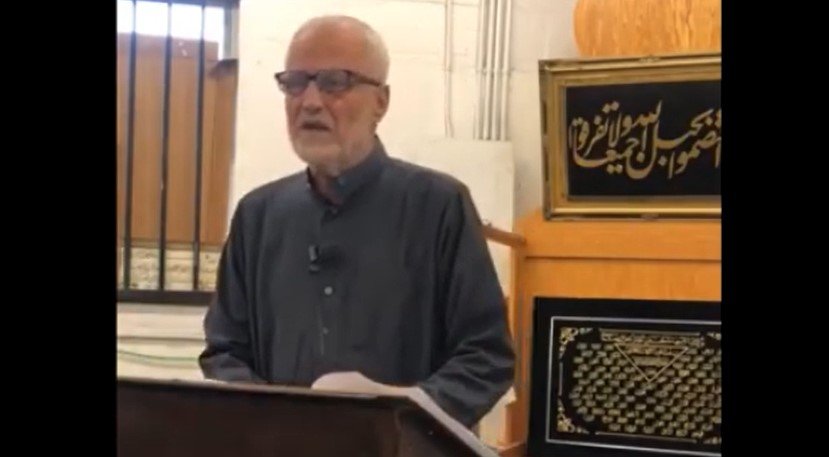
The contrast with Catalan education: two childhoods, two worlds
While Catalan girls practise sport, learn languages or take part in artistic activities, others are brought up to occupy a silent and subordinate space within the family and the religious community. A few metres from the urban life of the Paral·lel, where theatre, leisure and multiculturalism blend, There are girls who memorise ancient texts and learn that their worth lies in obedience and purity..
This contrast generates an obvious clash of values: on the one hand, The Catalan school promotes equality, co-education and personal freedom; on the other hand, centres such as Faizan e Sahabiyat teach that women should have neither a voice nor a public presence.a. This divergence of messages can affect social cohesion and jeopardise girls' real access to fundamental rights.
European precedents: alarms activated
In France, The government has closed private Islamic schools and Salafist associations that were spreading messages contrary to republican values and gender equality.. In the United Kingdom, the scandal known as «Trojan Horse» revealed attempts to control state schools to promote an ultra-conservative Islamic agenda. In Belgium and the Netherlands, Dawat-e-Islami has been monitored by the authorities because of its educational and community activities..
These cases have set alarm bells ringing about the existence of non-formal teaching networks, often invisible to public authorities, which can become hotspots of radicalisation or structural segregation. The case of the Paral·lel centre fits this pattern, despite the fact that so far there has been no intervention by the Catalan institutions. “Non-regulated” educational centres do not fall within the remit of the Educational Inspectorate. Their curriculum, methodologies and how they manage teaching time are not regulated. This creates a vacuum: they are entirely outside the education regulatory system but carry out formative activities, many hours a week, and provide training in values and beliefs.
Today, in Barcelona, girls who live in a Western and democratic environment They are conditioned to accept a life of submission, without any educational, social or judicial authority intervening. The city that presents itself as the capital of freedom and diversity coexists with spaces where women have no voice. It is a silent reality, but no less real.
More about Education

Azerbaijan expels students who wear Islamic headscarves from school
Teacher fired in Austria for denying a Muslim woman a prayer room
Italy bans burqa and niqab but only in schools
The Generalitat pays tribute to the racist Abu Bakr al-Turtuxí as an anti-racist icon
A student residence in Scotland imposes Islamic law in common areas
Kazakhstan threatens to close private schools that allow hijab

More Perceptions of
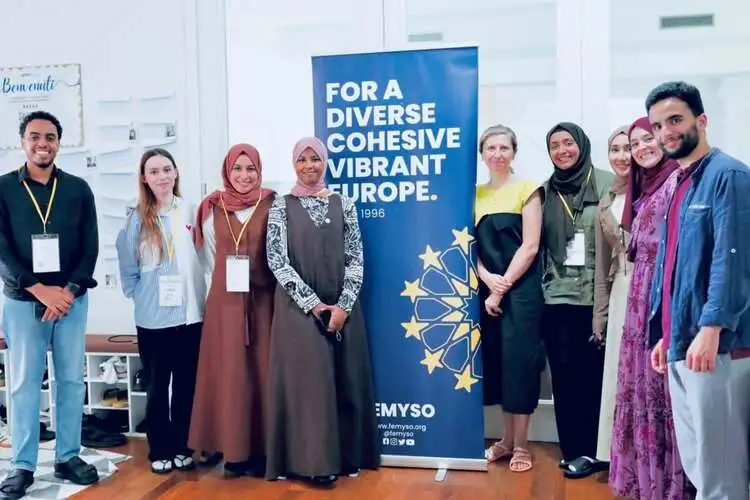
ERC, PSC and Comuns oppose combating political Islam in the European Parliament.
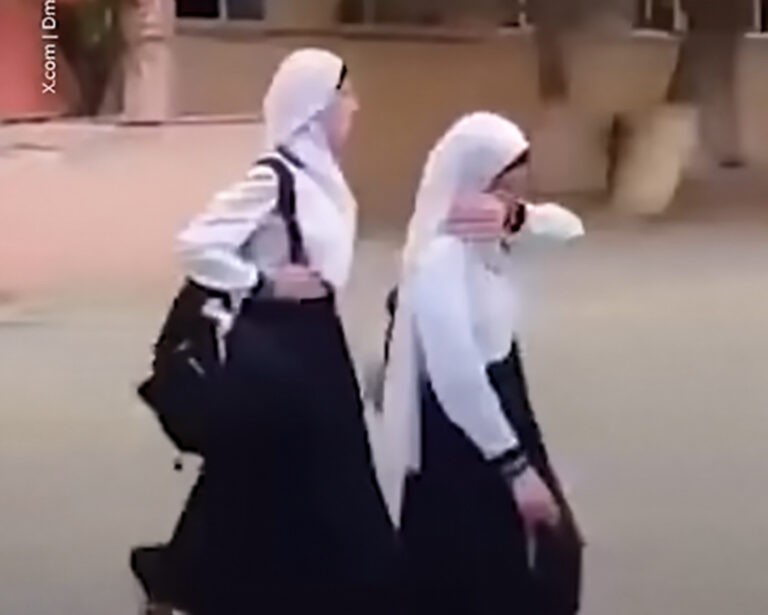
Azerbaijan expels students who wear Islamic headscarves from school

Sharia law in the US is supported by 75% of Muslims, 41% of atheists and up to 20% of Christians.
France now has a halal meat supply without the need to sacrifice animals facing Mecca.
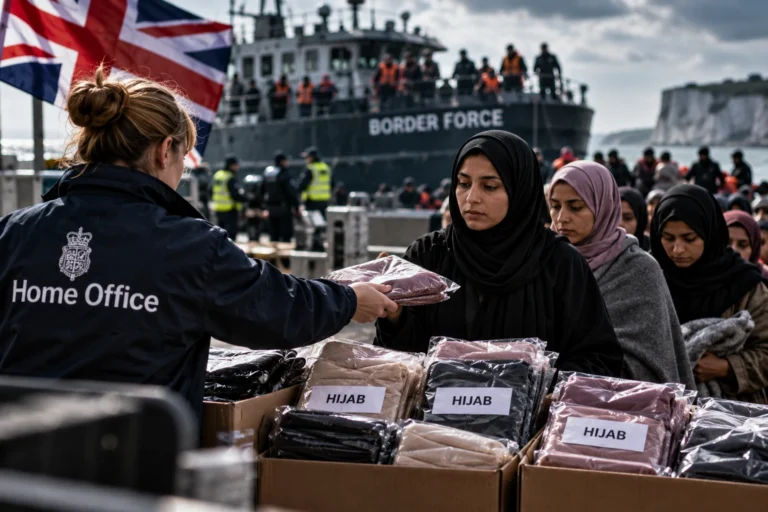
The United Kingdom gives away a thousand hijabs in six months to immigrants arriving via the Channel
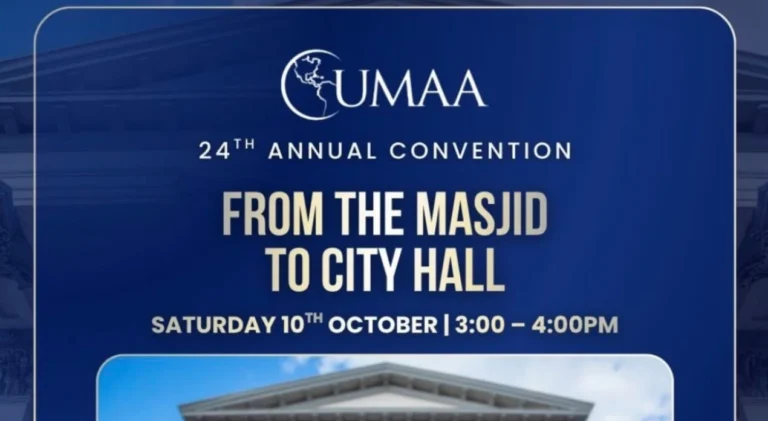
US Muslim politicians train Canadian Muslims under the slogan "From the mosque to the city hall"«
Teacher fired in Austria for denying a Muslim woman a prayer room
Canadian government normalizes Islamic prayer during workday
Lleida bans the burqa except if worn for religious reasons
Italy bans burqa and niqab but only in schools
The Generalitat pays tribute to the racist Abu Bakr al-Turtuxí as an anti-racist icon
A student residence in Scotland imposes Islamic law in common areas
Kazakhstan threatens to close private schools that allow hijab
A Catholic university in Belgium incorporates Islamic chants into the opening mass of the course
A Muslim family in Granada chooses a Catholic school and demands that the courts teach Islam there
Phrase of the Week

Image of the Week
-Don't you have cousins?