
The Catalan Government offers secondary schools materials that defend the Islamic veil and question Western feminism
A DGAR guide offers teachers activities to question Western feminism. It presents criticism of the Islamic veil to secondary school students as an expression of colonialism.
Illustrative image // AI
[social-share align=»right» style=»button» mobile_app=»desktop»]
[social-share align=»center» style=»icon» mobile_app=»mobile»]
The Generalitat (the Government of Catalonia) offers secondary school teachers some educational materials that question Western feminism and present the Islamic veil as a possible expression of female freedom. The documents are part of the project Women, spirituality, feminisms, produced by the UNESCO Association for Interreligious Dialogue (AUDIR), commissioned by the Directorate General for Religious Affairs. The first publication dates from 2019, when the governing coalition was formed by Junts per Catalunya and ERC, led by Quim Torra. The body that commissioned the work was part of the Department of Justice, then headed by Ester Capella, of ERC.
The project includes three publications: Women, spirituality, feminisms, the teaching dossier with activities for secondary school students and a guide for teachers that explains how to use them in class. The last two documents were presented in 2021 with the aim of exploring the relationship between religion and feminism from the perspective of the different religious traditions. The Directorate General for Religious Affairs of the Generalitat of Catalonia still offers all three documents on its official website as educational resources for exploring religious diversity.
Questioning the West from Western classrooms
Criticism of the West does not remain a theoretical reflection. The Catalan government’s educational materials propose activities for students to question Western feminism. The documents associate the feminist view of the Islamic veil with a “patriarchal and colonial” perspective. This interpretation goes so far as to present the defence of women’s rights as a colonial attitude and a display of cultural superiority. According to this approach, it is wrong to assume that the Islamic veil is a symbol of oppression because this means judging Muslim women by Western criteria.
Criticism of the West is carried directly into school activities. On page 22 of the teaching dossier, secondary school students must work on a text that presents the Western outlook as “patriarchal and colonial”. The idea it conveys is that Westerners act with superiority when they judge other cultures and religions according to their own values. The exercises start from a critical interpretation of the West that students must develop in class. The Generalitat of Catalonia offers teachers a proposal that presents Western values as potentially colonial even when they are used to defend women’s rights. The Islamic veil thus becomes an example for questioning the Western idea of feminism.

An aim of social transformation
The authors of the teaching dossier Women, spirituality, feminisms do not hide their intention to go beyond introducing the different religions. On page 3, they define the material as a “tool for social transformation” and question a “fairly hegemonic” feminism that considers religions incompatible with women’s liberation.
The Islamic veil is one of the examples the authors use to defend this perspective. On pages 21 and 22 of the main document, they criticise the idea that Muslim women will eventually abandon the headscarf as they move towards modernity. According to the authors, expecting Muslim women to remove the veil through contact with the West denies their “ability to make decisions”.
This approach turns the feminist critique of the Islamic veil on its head. Instead of considering that this garment may represent a religious imposition, the authors focus on the prejudices of those who question it. The Western outlook is described as a perspective that “is neither objective, nor neutral, nor universal”. In this way, the suspicion of patriarchy shifts from the religious practice to the Western outlook that criticises it.
No criticism of pressure to wear the veil
The freedom advocated by the documents seems to have a preferred direction: defending Muslim women who wear the veil. The authors question Western prejudices against this practice and insist that women have the capacity to decide for themselves. But this concern does not translate into equivalent criticism of the family, social or religious pressure that women who want to remove it may face. The contrast is particularly significant in educational materials intended to reflect on women’s freedom.
The Catalan government thus offers teachers a reflection on the right to wear the veil, but without devoting any attention to the right to reject it.
Towards religious experience in the classroom
The materials from the Generalitat of Catalonia go beyond the theoretical study of religions and propose that students directly experience some spiritual practices. On page 48 of the teaching dossier, the proposal is to invite someone to the school to lead a meditation experience. Activities involving religious music, reading sacred texts and moments of prayer or meditation are also proposed. The Catalan government thus offers teachers a guide that moves from explaining religious beliefs to proposing that students experience them personally.
The proposed spiritual experience is part of a project that aspires to transform the way students think. On page 49, the authors state: “You certainly do not think the same way before starting as you do after exploring the different traditions in depth and experiencing them”. The same intention appears on page 25, where students must complete the exercise “I used to think… Now I think…” after working on the critique of the Western perspective. The dossier thus invites students to revisit their convictions after questioning Western feminism and learning about different religious experiences. There is no indication that teachers are required to grade students according to whether they change their minds, but the exercises explicitly incorporate this personal reassessment.
The AUDIR association prepared these documents on commission from the Generalitat of Catalonia. The organisation is dedicated to interreligious dialogue and advocates the presence of religious culture in state schools. The materials question Western feminism’s critique of the Islamic veil and argue that wearing it is an expression of women’s freedom and emancipation. And it is this vision of women’s emancipation that the Directorate General for Religious Affairs of the Catalan government continues to make available to secondary school teachers.
More Perceptions of
More veils

The main Islamic organisation in the US is calling for diplomatic pressure to persuade Azerbaijan to allow the hijab in schools
Azerbaijan expels female students who wear the hijab.
The United Kingdom gives away a thousand hijabs in six months to immigrants arriving via the Channel
Lleida bans the burqa except if worn for religious reasons
Italy bans burqa and niqab but only in schools
Kazakhstan threatens to close private schools that allow hijab
Convicted in Mallorca for gender violence for imposing the hijab, controlling and assaulting
Muslim teacher in Flanders prefers unemployment to taking off her hijab
Even Kadyrov's Islamized Chechnya doesn't want women with their faces covered with the niqab


Several UK police forces warn that celebrating Halloween may upset Muslims
A new Barcelona contract imposes the halal menu on social services
Italian bishops promote the Qur’an in schools as the “revealed word of God”

Austria removes Muslim police trainee who refused to work with men

A Muslim is hunted down in Tarragona and another in Vilafranca del Penedès for jihadist activity.

Allah’s law now has a sharia court in Italy

The Halal Institute of the Spanish Islamic Council rejects stunning chickens before slaughter


A Muslim decapitates a statue of Saint Joseph in a church in France

The German justice system rules in favour of a school that bans Muslim pupils from praying
The Catalan Government wants prayer rooms in companies so that Muslims can pray
A German state detects 358 Muslim child marriages and does not intend to do anything
Phrase of the Week

Image of the Week
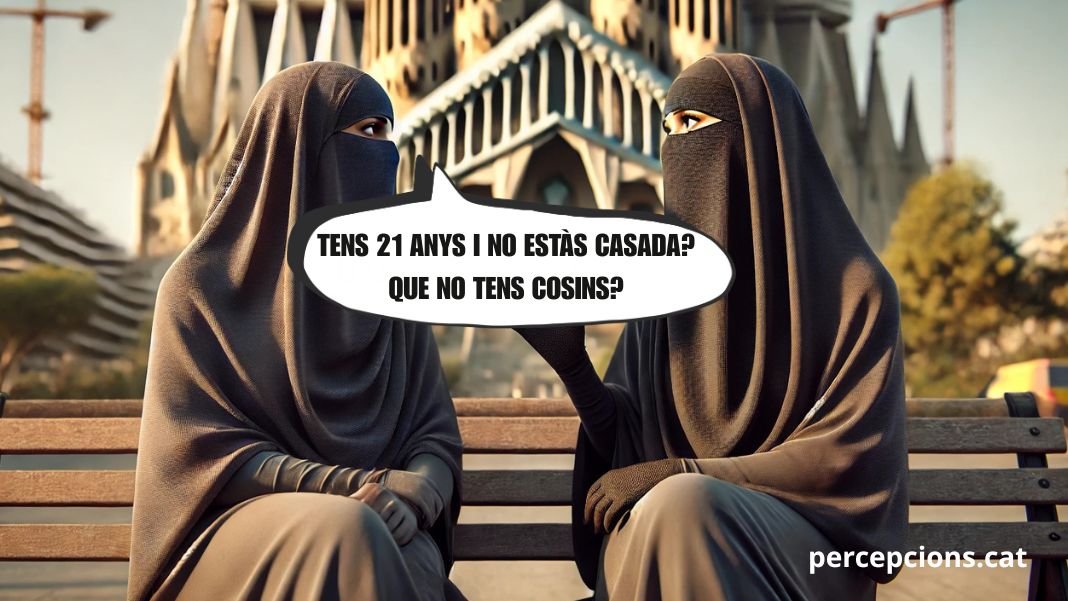
-Don't you have cousins?