
The Government of Catalonia proposes prayer rooms in companies so Muslims can pray
An official guide recommends providing spaces for prayer, adapting schedules and allowing Muslim religious beliefs to shape the organisation of work.
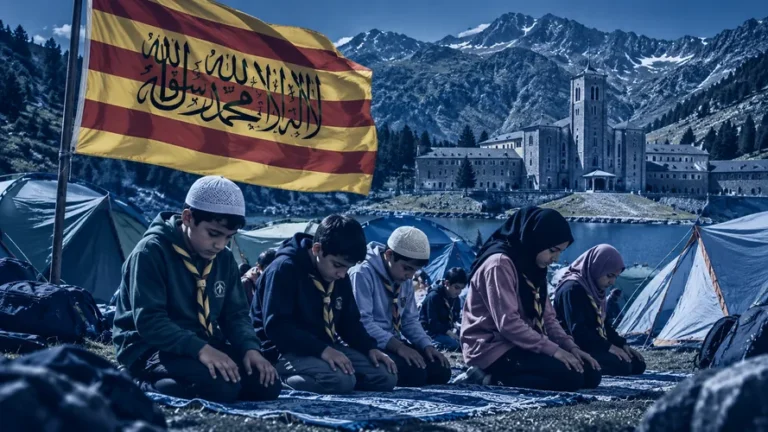
Illustrative image // AI
[social-share align=»right» style=»button» mobile_app=»desktop»]
[social-share align=»center» style=»icon» mobile_app=»mobile»]
The Generalitat (the Catalan government) encourages public administrations and companies to adapt their operations to religious requirements, invoking diversity, interculturality and religious freedom. This discourse includes Christianity, Islam, Judaism, Sikhism, Hinduism and other faiths. But when specific workplace adjustments are set out, 80% of them relate directly to Islamic practices. The remaining recommendations mainly concern Judaism and Adventism with regard to Sabbath rest, and Sikhism with regard to the wearing of the turban.
To adapt the organisation of work to religious needs, the Generalitat has published the Guide to respecting freedom of religion and conscience in employment relations. The document recommends providing prayer rooms, allowing prayer breaks, adjusting working hours during Ramadan and ensuring that certain workers do not have to handle foods prohibited by their beliefs. The Generalitat presents these measures as good practice for companies and public administrations, although they are not generally mandatory.
Another aspect of the administration's religious accommodation policy is the training of civil servants. The Generalitat organises courses so that civil servants adapt the way they deal with citizens to their religious beliefs. The training is aimed at staff in public-facing services, education, healthcare and social services. The next event, scheduled for 23 November, will go beyond services for citizens: it will address the participation of religious organisations in shaping public policy.
Rooms for trade union activities, coffee, breastfeeding… and prayer?
The section on page 67 of the Generalitat's religious guide proposes that companies and public administrations provide a room where workers can pray. To make the proposal seem more ordinary, it compares prayer rooms with spaces for having coffee, resting, breastfeeding or carrying out trade union activities.
The proposal is reminiscent of what is already happening in Canada: a parliamentary inquiry has identified 1,000 Muslim prayer rooms in federal government buildings. These spaces were presented as rooms for silence, meditation, rest or private calls. In a short time, Muslim officials have made them their own because no one was using them. In practice, they have ended up being used as Muslim prayer rooms, with prayer mats, copies of the Qur'an and indications of the direction of Mecca.
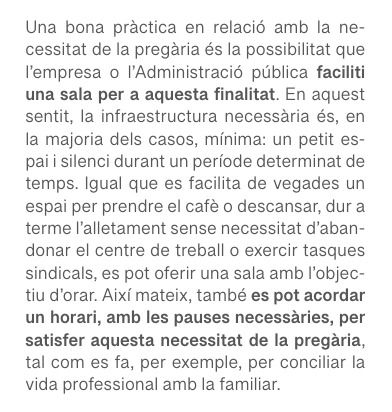
In Catalonia, the Generalitat does not hide the religious purpose behind labels such as “quiet rooms”, “meditation” or “rest”: it directly proposes setting up prayer rooms in workplaces. It presents it as a general need for religious diversity, but the examples in the guide specifically highlight Islam. It discusses Muslim prayers, providing breaks during the working day and offering spaces in which to practise them. In this section, it does not identify any equivalent demands from Christians, Jews or other denominations. The proposal is for all religions, but the specific example used by the Generalitat is Muslim.

Changing working hours and tasks during Ramadan
The Generalitat also proposes adapting the organisation of work for Muslims observing Ramadan. On page 68, the guide recommends bringing forward the start of the working day, introducing continuous working hours, concentrating tasks in other periods of the year and facilitating shift swaps between Muslim and non-Muslim workers. It also proposes greater flexibility for taking breaks and cooling down during the fast.
The recommendations extend to the workers' duties. The guide recommends temporarily avoiding physical exertion and working at height, and taking extra care with heavy machinery. The Generalitat justifies these adaptations to prevent the risks associated with fasting, but the result is that a voluntary religious practice can lead to changes in schedules and in the allocation of tasks. The document also recommends taking into account Muslims who wish to spend Ramadan with their families when organising holidays.
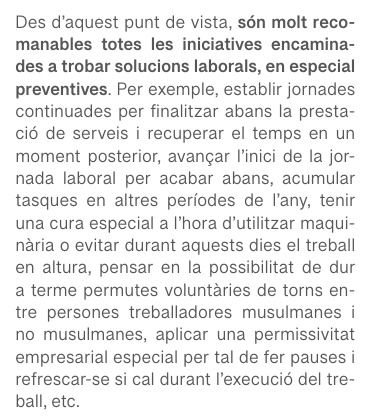
The Generalitat wraps everything up in the discourse of «religious diversity», but the measures in this section have one clear target: Muslim workers. It is no longer limited to asking for workers' religion to be respected: it recommends changing the way companies operate to meet their religious requirements. No other religion receives similar treatment: Islam is the only one for which the guide proposes reorganising working hours, shifts and tasks. And for an entire month.
Let them not touch pork!
The Generalitat also proposes adapting workers' tasks to religious dietary prohibitions. Here Islam has company: Judaism. The guide recommends that companies avoid assigning employees who follow a religion that has issues with pork to a supermarket's butchery.
The Generalitat assumes in this guide that Islam forbids touching pork, although the Qur'an states that it must not be eaten. The refusal to handle, cook, transport or sit at a table where pork is present stems from religious interpretations. Despite disputes among Islamic jurists on this point, the Generalitat accepts the most radical interpretation and recommends that companies adapt workers' tasks to avoid any physical contact with pork. This is how a disputed religious interpretation becomes an official recommendation on how a company should operate.

The only labour dispute over pork covered by the guide is that of a Muslim worker who in 1997 refused to handle and sell pork and alcohol.. The High Court of Justice of Madrid ruled against her. The Generalitat cites this judgment, but recommends that companies avoid assigning these tasks to workers who refuse them on religious grounds. The paradox is that the Generalitat promotes this as a best practice. that which the court did not recognise as a right and which the Qur'an does not establish as a prohibition.
Expressing religious diversity through dress
The Generalitat wants that that religion be visible in the appearance of officials. On page 99 of the guide, He considers it enriching that the appearance of civil servants reflects the religious diversity of Catalonia.. According to the document, This exhibition would help to incorporate members of religious minorities into the Administration. and to win the trust of citizens who share these beliefs. Thus, what begins as a matter of individual freedom ends up as a recommendation that the Administration display religious diversity through its employees.
Islam also features prominently in this section because of its use of the hijab. The guide analyses several court judgments (pages 76–78), which recognise the right of Muslim women workers to wear the veil. These cases serve the Generalitat to Remember that companies cannot prohibit the hijab arbitrarily.
The same guide recognises that this attire may compromise the Administration's religious neutrality. On page 98, it recommends that teachers in public schools be cautious about religious symbols. But on the following page it says that displaying them is enriching. The paradox is that what is presented as a potential problem of neutrality in classrooms becomes a desirable display of diversity in other public settings.
You can try to convince your colleagues.
The guide also addresses the possibility of spreading religious ideas among colleagues. On page 78, it recognises this right even when seeking to persuade others to join a denomination. On page 79, it specifies that workers may do so during breaks and that They do not need to obtain the prior consent of their peers.. They should only stop when the other party clearly indicates that they do not wish to continue discussing religion. The document prohibits devoting actual working time to it and warns that persistence may constitute harassment.
The result of all this is that religious beliefs cease to be a personal matter of workers and become a criterion that shapes the organisation and operation of public services.. The Generalitat proposes that companies and public administrations adapt their operations to religious practices that until now have not been part of the usual organisation of work. They are not yet obligations, but recommendations underpinned by diversity and religious freedom.
↓ Download the Generalitat guide (PDF)
More Perceptions of
More Islam in Catalonia

A Muslim is hunted down in Tarragona and another in Vilafranca del Penedès for jihadist activity.
ERC, PSC and Comuns oppose combating political Islam in the European Parliament.
Lleida bans the burqa except if worn for religious reasons
The Generalitat pays tribute to the racist Abu Bakr al-Turtuxí as an anti-racist icon
Who is Fatiha El Mouali, much more than the helpless immigrant from the newspaper ARA
Transcription of Ramon Cotarelo's speech in Ripoll for the 2026 Diada
Barcelona City Council spends 44,000 euros to "learn about the Muslim practices we carry within"
Islamic marriage in Catalonia requires a guardian to authorize the woman


Austria removes Muslim police trainee who refused to work with men

A Muslim is hunted down in Tarragona and another in Vilafranca del Penedès for jihadist activity.

Allah’s law now has a sharia court in Italy

The Halal Institute of the Spanish Islamic Council rejects stunning chickens before slaughter


A Muslim decapitates a statue of Saint Joseph in a church in France

The German justice system rules in favour of a school that bans Muslim pupils from praying

A German state detects 358 Muslim child marriages and does not intend to do anything


United Airlines removes a Muslim pilot from service for justifying terrorism


ERC, PSC and Comuns oppose combating political Islam in the European Parliament.
Azerbaijan expels female students who wear the hijab.

Sharia law in the US is supported by 75% of Muslims, 41% of atheists and up to 20% of Christians
Phrase of the Week

Image of the Week
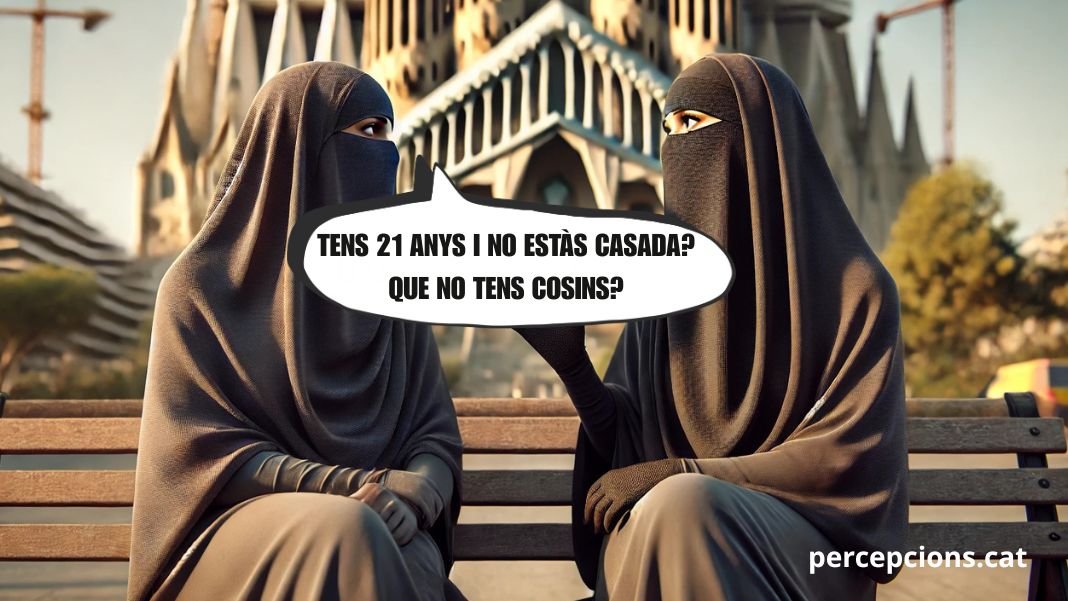
-Don't you have cousins?