
A new Barcelona contract imposes halal menus on social services in Eixample
The contract also requires that 20% of the workers demonstrate «cultural and linguistic diversity.».
Illustrative image // AI
[social-share align=»right» style=»button» mobile_app=»desktop»]
[social-share align=»center» style=»icon» mobile_app=»mobile»]
The Barcelona City Council has published a new contract worth more than €762,000 to launch a social service in the Eixample district. The new service will offer support to families with children up to the age of 16 who face social or family problems. It will include activities for children, workshops for parents, help to improve family life at home, and psychological and educational support. It will also have a space where families can prepare and share meals using food provided by the company that runs the centre.
The contract’s tender specifications state on page 21 that meals must be adapted to families’ religious dietary requirements. The wording says they must take account of “food allergies and intolerances or other medical requirements, as well as preferences based on religious or cultural criteria”. This allows Muslim families to request food that meets Islam’s dietary requirements. The document does not explicitly describe the menu as halal, but this clause allows meals to be adapted to their spiritual needs.
20% of staff must meet the diversity requirement
The contract’s administrative specifications, on pages 43 and 44, require that at least 20% of staff demonstrate “diverse linguistic and cultural knowledge”. The City Council justifies this requirement on the grounds that 29.9% of Eixample residents are foreign nationals. This means that speaking Catalan and Spanish and having the necessary professional training may not be enough to fill this 20% of the workforce. A candidate with these abilities may be excluded from these posts in favour of another who can demonstrate the additional cultural or linguistic knowledge required.
The specifications also set out how this knowledge can be demonstrated: language certificates at a minimum B1 level, but also links to other countries, such as nationality, place of birth, education or work experience. The assessment therefore goes beyond what a worker can do: information about their personal background can be used to demonstrate “diversity”. A Catalan who has only studied and worked in Catalunya may find it harder to meet this requirement than a candidate with verifiable links abroad, even if both have the same professional qualifications.
From halal school meals to halal social services
Adapting menus to Islamic rules is nothing new in Barcelona. In 2016, the Barcelona Education Consortium approved a directive requiring school canteens to offer menus adapted to families’ religious beliefs. At municipal nursery schools, pork was removed from the menus, while the available options still included halal. Religious diversity was already directly affecting what children ate.
An analysis of menus at 65 state schools in Barcelona found that 15 schools served no pork on any day of the month, while many others served very little. It was also documented that in Barcelona’s schools, halal meat is served to everyone, although they do not offer a separate religious menu. Adapting to Muslim requirements has ultimately determined the overall menu.
Now the new Eixample contract extends this religious accommodation to social services and opens the door to buying even more halal meat with public money. Behind this certification lies a business built on religious fees and audits: Islamic organisations charge to verify that slaughterhouses, factories and industrial processes comply with Islamic rules. In addition, the halal slaughter process requires animals’ throats to be cut without prior stunning, a practice that Western science has shown to cause suffering.
As a result, religious rules dating back fourteen centuries are gaining ground in Barcelona’s public services, shaping what is bought, what is cooked and how taxpayers’ money is spent. Religious accommodation ceases to be a private decision and becomes a contractual obligation for public authorities. Gradually, Islam’s religious requirements are making their way into more and more areas of Barcelona’s public services, becoming conditions that public authorities write into their contracts.
More halal

The Halal Institute of the Spanish Islamic Council rejects stunning chickens before slaughter
France now has a halal cola drink without the need to sacrifice animals facing Mecca
A student residence in Scotland imposes Islamic law in common areas
Halal logistics arrives: separate lorries and warehouses for Muslim food
The Barxiluna project turned 80 years of al-Andalus into Barcelona's eternal debt to Islam
A Muslim father denounces a Swedish judo club for not adapting the greeting to Islam
Muslims ban pork cooking at public barbecues in Austria
Human rights report claims Ireland served pork sausages to deportees to Pakistan
German police investigate kindergarten cook for serving pork to Muslims

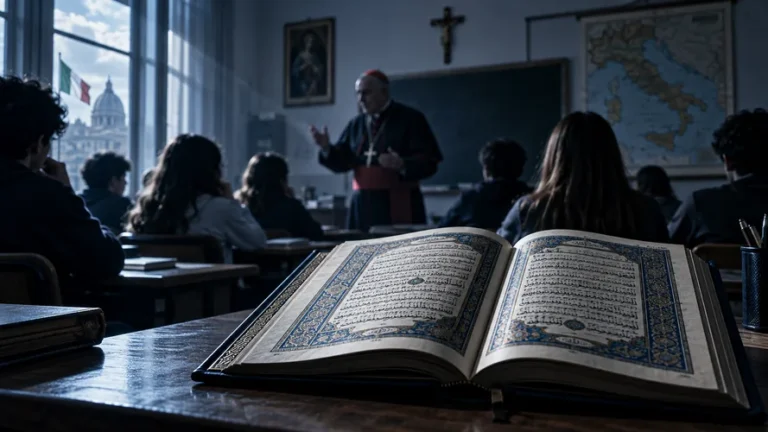
Italian bishops promote the Qur’an in schools as the “revealed word of God”

Austria removes Muslim police trainee who refused to work with men

A Muslim is hunted down in Tarragona and another in Vilafranca del Penedès for jihadist activity.

Allah’s law now has a sharia court in Italy
The Halal Institute of the Spanish Islamic Council rejects stunning chickens before slaughter

A Muslim decapitates a statue of Saint Joseph in a church in France
The German justice system rules in favour of a school that bans Muslim pupils from praying
The Catalan Government wants prayer rooms in companies so that Muslims can pray

A German state detects 358 Muslim child marriages and does not intend to do anything

United Airlines removes a Muslim pilot from service for justifying terrorism

Phrase of the Week

Image of the Week
-Don't you have cousins?