Left-wing municipal candidates in Italy ask for votes in Bengali or Arabic “in the name of Allah”
Muslim candidates, women wearing veils, posters in foreign languages and religious calls are fully entering the May municipal campaign. Venice is the most visible case, with seven candidates from Bangladesh.
Electoral propaganda for the 2026 Italian local elections.
[social-share align=»right» style=»button» mobile_app=»desktop»]
[social-share align=»center» style=»icon» mobile_app=»mobile»]
The municipal elections on 24 and 25 May in Italy have opened a new political front: Candidacies from the traditional left or local platforms have included Muslim candidates, posters in foreign languages, women wearing the veil and religious messages. addressed directly to immigrants.
What until now had been presented as integration is beginning to show another face. Now religious identities have become an electoral tool and demands such as the construction of mosques or gender segregation are entering municipal institutions. Venice, Agrigento and Lecco are three examples of the Introduction of symbols, language and agendas linked to Islam into Italian political life.
Venice flooded by Islam at the hands of the Democratic Party
The Democratic Party is the main centre-left party in Italy, heir to the post-communist and social-democratic tradition. In Venice, the PD is standing in the municipal elections on 24 and 25 May with Andrea Martella and a team that includes seven candidates of Bangladeshi origin. The case attracts attention because They run a campaign explicitly aimed at voters of Bangladeshi origin, with leaflets in Bengali and religious appeals. and a very clear demand in the background: the construction of a new mosque. The posters that have been lit up in Bengali feature the flag of Bangladesh and open with the formula: “In the name of Allah, the Most Gracious, the Most Merciful”This election campaign does not speak to the residents of Venice as a whole, but to a specific community, in their native language and with an Islamic call to prayer at the forefront.
The Bangladeshi community in Venice, according to Il Giornale, could reach to around 20,000 people and has around 4,000 potential votes, a figure significant enough to sway a tight municipal election. The conflict has intensified because the campaign coincides with the battle over the mosque. The League has responded with adverts on municipal buses bearing the slogan “No to the mosque, vote for the League”The response of the candidates linked to the PD has been to present these posters as an offence to Muslims and as a message of cultural hatred.
But the centre-right has taken the debate beyond the mosque. Ermelinda Damiano, president of the Venice Municipal Council and candidate on the civic list, has pointed to the root of the problem: It is not just a question of origin, but of a social model.. According to Damiano, A worldview that normalises the veil, female submission and the lack of freedom for women to dress, study or have economic independence is incompatible with the values on which civil coexistence has been built..
In Lecco there are ten Muslim candidates with links to a controversial mosque.
In Lecco, the situation takes on a different form. According to information gathered by the Italian press, there are approximately ten Muslim candidates in a single medium-sized municipality. Among them is Hicham Bouraghba, a candidate for the Greens and Left Alliance, a formation linked to the ecological and post-communist left. Bouraghba is associated with the association “La Città”, an Islamic cultural centre on Via Promessi Sposi, which He has been surrounded by controversy for his proximity to radical imams and for demanding separate spaces for men and women..
The controversy doesn't arise from nowhere. In Lecco, the left-wing mayor Mauro Gattinoni had already taken part in an iftar, the breaking-of-fast meal for Ramadan organised by the city's Muslim cultural centre. Carlo Piazza, the League's candidate for deputy mayor, warned that the issue was no longer just religious but political: one wondered whether Lecco would end up following the path of other left-wing-run municipalities that have gone so far as to close schools to celebrate the end of Ramadan.
In Agrigento, a conversation in an Islamic context says that Allah and the Christian God are the same.
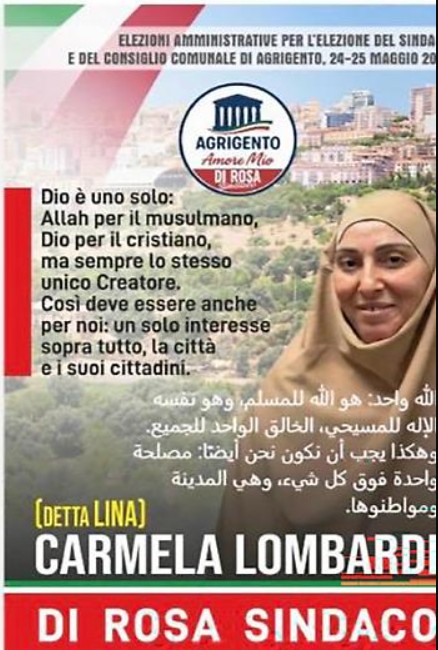
In Agrigento, the case revolves around Carmela Lombardi, a Neapolitan convert to Islam who is standing in the local elections on a citizens' platform that she leads. Giuseppe Di Rosa. Her campaign material combines Italian and Arabic, features a woman wearing a hijab and includes an explicit religious message: “God is one: Allah for the Muslim, God for the Christian, but always the same one Creator.”. The candidacy also incorporates Adnane Khezar, a Moroccan businessman, has sparked controversy by placing Islamic identity at the centre of the municipal campaign.
The controversy began on social media, with criticism of the presence of Muslim candidates on the list. The head of the list has defended them and said that having them with him is “a source of pride.” and presents them as a formula for coexistence. But the poster goes far beyond a local proposal: introduces the Arab, the veil and a theological statement in the midst of an election campaign.
Candidacies to represent a community, not the citizens
The main criticism from the Italian centre-right is that these candidacies are not intended to represent the residents as a whole, but to mobilise specific communities. Raffaele Speranzon, a senator for Fratelli d'Italia, summed it up by saying that The case of Venice seems to be “a de facto recognition of the separation”: a community that represents itself, not the city.. The League has also focused on the same point. According to Brunello Riccardo, the League's candidate in Venice-Mestre, the use of slogans in Bengali and religious references such as “in the name of Allah” raises a fundamental political question: to what extent can faith and institutions be mixed in a municipal election campaign. The problem, for critics, is not just that there are Muslim candidates, but that the campaign is aimed at a closed community with its own language, its own symbols and its own agenda.
This debate could grow even further in 2027. Francesco Tieri, of the “Muslims for Rome” movement, has used the case of Lecco as an example: if in each of the 2,000 municipalities that will vote in 2027 there were ten Muslim candidates, Italy could see up to 20,000 candidates of this profile in a single call.. It is a political projection, but it serves to understand the alert: what today seems anecdotal in some cities could become a national strategy for institutional presence.
More Perceptions of
More about Italy

Italy bans burqa and niqab but only in schools
Sharia arrives at Rome's swimming pools with women-only lanes
Muslims take an Italian MEP to court for filming a woman in a burqa in the street
Posters with the message «rape Christians» appear in Italy
Muslims expel bikini-clad girls from a park in Venice because they feel “provoked”
Muslims in Italy are taking advantage of May Day to demand public holidays in the work calendar.

ERC, PSC and Comuns oppose combating political Islam in the European Parliament.
Azerbaijan expels students who wear Islamic headscarves from school
Sharia law in the US is supported by 75% of Muslims, 41% of atheists and up to 20% of Christians.
France now has a halal meat supply without the need to sacrifice animals facing Mecca.
The United Kingdom gives away a thousand hijabs in six months to immigrants arriving via the Channel
US Muslim politicians train Canadian Muslims under the slogan "From the mosque to the city hall"«
Teacher fired in Austria for denying a Muslim woman a prayer room
Canadian government normalizes Islamic prayer during workday
Lleida bans the burqa except if worn for religious reasons
Italy bans burqa and niqab but only in schools
The Generalitat pays tribute to the racist Abu Bakr al-Turtuxí as an anti-racist icon
A student residence in Scotland imposes Islamic law in common areas
Kazakhstan threatens to close private schools that allow hijab
A Catholic university in Belgium incorporates Islamic chants into the opening mass of the course
A Muslim family in Granada chooses a Catholic school and demands that the courts teach Islam there
Phrase of the Week

Image of the Week
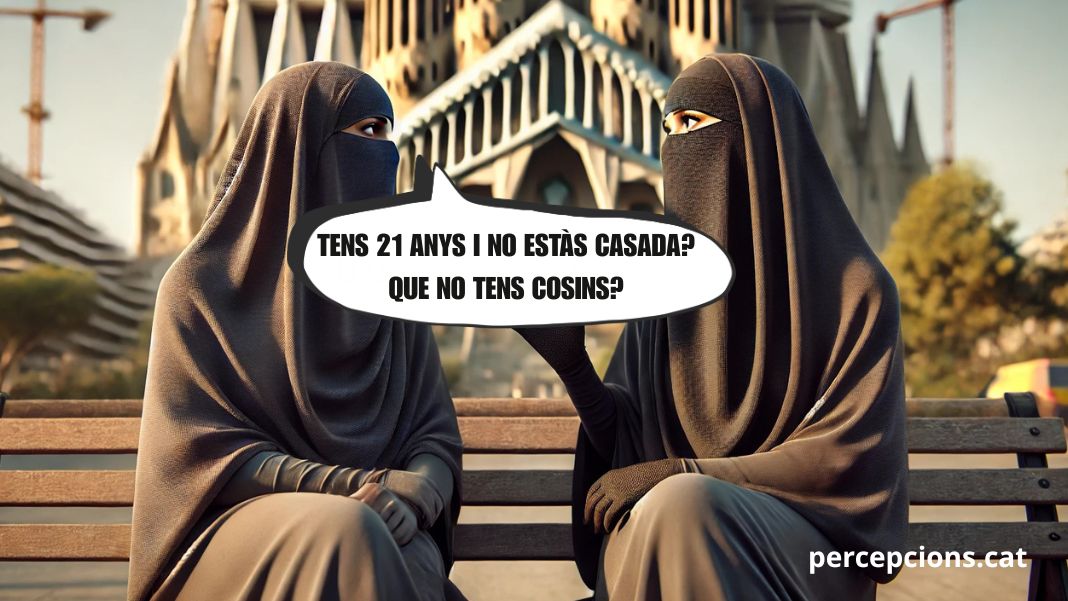
-Don't you have cousins?