
The Muslim Brotherhood is betting on the University of Texas as a model to replicate throughout the West
A complex linked to the Muslim Brotherhood combines religion, training and Islamic residence next to the University of Austin.
[social-share align=»right» style=»button» mobile_app=»desktop»]
[social-share align=»center» style=»icon» mobile_app=»mobile»]
What is being built today in Austin, Texas, is not simply a new mosque or an extension of an existing religious centre. It is a comprehensive ideological infrastructure project, designed to operate continuously around university life., and explicitly conceived as a model to be exported to other campuses in the United States and the Western world. The epicentre is the reconstruction of the Nuts Mosque, located a few metres from the University of Texas at Austin (UT Austin).
The project's promoters do not hide their objectives. In public fundraising events, internal documents and official presentations, They define the initiative as a “model”, a “beacon” and an “ecosystem” intended to transform the relationship of Muslim students with the university.t, American society and, ultimately, the secular state. The university is not seen as a neutral space of knowledge, but as an ideological battleground where structural intervention is required.
This project, according to its own promoters, is part of a long-term strategy. associated with the Muslim Brotherhood ecosystem. The underlying idea is to train community leaders who will replicate the associative model in their professional field of expertise.
The consolidated presence of the Muslim Brothers at the University of Texas
The Nueces Mosque did not begin as a neighbourhood mosque that later reached out to the university community. It was born, from the very outset, within the student environment. It was founded in 1977 by members of the Muslim Students Association (MSA) of the University of Texas. This detail is not anecdotal: the MSA was created in the United States in the 1960s. mainly by members and supporters of the Muslim Brotherhood, with the explicit aim of establishing permanent Islamic institutions in the West, especially on university campuses.
During a public event held in January 2025, one of the project's founders openly acknowledged that the initial purchase of the first property only It was made possible thanks to a $150,000 cheque from Saudi Arabia., channelled through the Saudi embassy. This foreign contribution was not a marginal detail: it was the decisive factor that enabled the establishment of a permanent physical presence alongside a major public university in the United States.
The university as an Islamic religious ecosystem
What is being built in Austin is not just a place of worship adjacent to the campus, but An infrastructure designed to encompass university life in all its dimensions.. The project is based on the premise that Continuous exposure to secular, pluralist or liberal values constitutes a threat to Islamic identity., and that it must be counteracted by creating a distinct, stable and controlled environment. The university, rather than transforming the individual, must itself be transformed—or, at the very least, neutralised—through parallel structures.
The projected complex It has an approximate surface area of 7,000 square metres. and is organised as a vertical structure where each element corresponds to a specific ideological function. At the base, lThe mosque occupies a central position, both physically and symbolically.. It is not conceived as just another religious service in the urban offering, but as the backbone of the entire system. The mosque becomes the constant point of reference, the axis around which time, conduct and community hierarchy are organised.
Above the strictly liturgical level, the project It includes dedicated spaces for doctrinal training and advanced religious education. These spheres do not function as cultural supplements, but as instruments of continuous ideological production. The Islamic seminary integrated into the complex Trains students in religious interpretation, community leadership and the normative application of Islam to everyday life.. In this way, the project not only supports the students but also produces graduates equipped to replicate the same model in other contexts.
Housing as a tool of religious control
The student residence It further reinforces this closed-ecosystem logic. The housing integrated within the complex. it allows the institutional influence to extend beyond prayer or formation hours. Living within this environment entails submitting to a regulatory framework that governs timetables, conduct, social relationships and personal practices. The boundary between the private and the religious disappears, and The student finds himself immersed in a system where community pressure, informal surveillance and clerical authority operate constantly.. This model reduces the capacity for critical distance and turns coexistence into an instrument of ideological conformity. This reduces the margin of friction with the plural university environment and creates a total continuity between faith, coexistence and identity. The result is that The student does not enter and leave a religious space; they live immersed in it..
The gender segregation It is a structural element of this residential model and not merely an organisational option. The spaces are designed to separate men and women both within the home and in social interaction, reinforcing a hierarchical and normativised conception of personal relationships. The separation of men and women here is not just another cultural option, but a structuring norm of coexistence. Men and women occupy distinct spaces, with specific rules regarding dress, behaviour and interaction.
The impact of this system also extends to non-Muslim people. Although no explicit prohibitions are formally established, Any resident is obliged to respect strict Islamic rules., regardless of their personal convictions. This gives rise to an indirect but effective exclusion, since living in this environment entails accepting an alien religious regime as a condition of coexistence.
A model designed to be replicated beyond Texas
The project managers have repeatedly stated that What is being built in Austin is not a local exception, but an exportable model. to the rest of the United States and indeed the West. The combination of a mosque, religious training, segregated housing and its own financial structure is not the result of improvisation but of an institutional architecture designed to function as a template. Austin thus serves as a testing ground, where a scheme is validated before being adapted to other campuses across the United States.
This drive for replication is explained by the strategic logic of the Muslim Brothers, which places the university at the heart of identity formation and generational succession. Students educated within this ecosystem are not only temporary users but bearers of the model. Once graduated, They have the organisational experience, the ideological framework and the necessary networks to promote similar initiatives in other cities. In this way, the project does not depend on a particular leader or a specific context, but is based on the systematic reproduction of frameworks and the consolidation of an institutional culture that can take root in diverse environments.
This project puts the limits of religious accommodation under strain and highlights the difficulties faced by public institutions in preserving a common framework in the face of structures that operate according to parallel logics. What is at stake is not only the coexistence of beliefs, but the university's capacity to uphold shared criteria of equality, individual freedom and the absence of ideological or religious normative impositions.
More Perceptions of
More about Muslim Brotherhood

ERC, PSC and Comuns oppose combating political Islam in the European Parliament.
Who is Fatiha El Mouali, much more than the helpless immigrant from the newspaper ARA
Austria prepares to ban Muslim Brotherhood political Islam
Germany prevents civil servant from being a civil servant due to ties with the Muslim Brotherhood
An official Austrian report accuses the Muslim Brotherhood of wanting to transform democracy from within.
The foundation that manages the Barcelona Office of Religious Affairs paid €175 to denounce Islamophobia
The Generalitat trains teachers with an Islamic preacher who denies Western equality between men and women
The University of Strasbourg paid the lawyers of a student who had denounced a researcher critical of the Muslim Brotherhood.
Germany's intelligence service warns of the infiltration of the Muslim Brotherhood into institutions and parties.

ERC, PSC and Comuns oppose combating political Islam in the European Parliament.
Azerbaijan expels students who wear Islamic headscarves from school
Sharia law in the US is supported by 75% of Muslims, 41% of atheists and up to 20% of Christians.

France now has a halal meat supply without the need to sacrifice animals facing Mecca.

The United Kingdom gives away a thousand hijabs in six months to immigrants arriving via the Channel
US Muslim politicians train Canadian Muslims under the slogan "From the mosque to the city hall"«
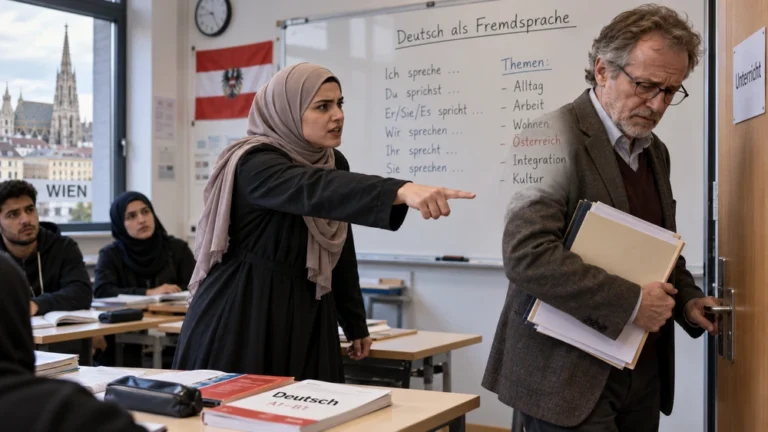
Teacher fired in Austria for denying a Muslim woman a prayer room
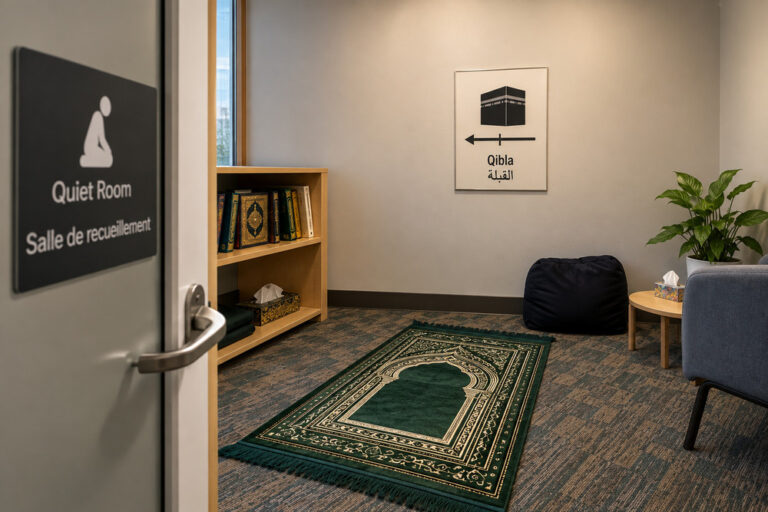
Canadian government normalizes Islamic prayer during workday
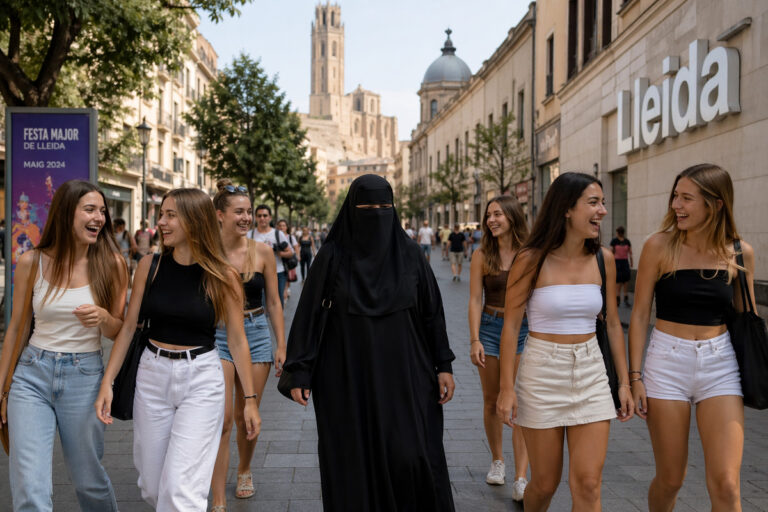
Lleida bans the burqa except if worn for religious reasons
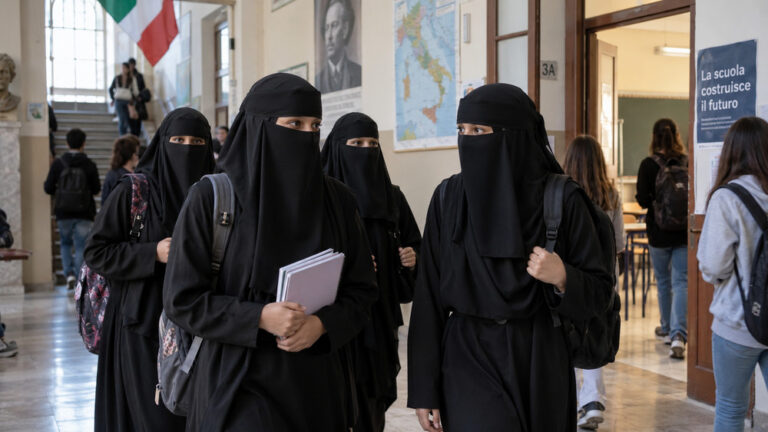
Italy bans burqa and niqab but only in schools

The Generalitat pays tribute to the racist Abu Bakr al-Turtuxí as an anti-racist icon
A student residence in Scotland imposes Islamic law in common areas
Kazakhstan threatens to close private schools that allow hijab
A Catholic university in Belgium incorporates Islamic chants into the opening mass of the course
A Muslim family in Granada chooses a Catholic school and demands that the courts teach Islam there
Phrase of the Week

Image of the Week

-Don't you have cousins?