
Mertixell Borràs (Junts) visited the Tarik Ibn Ziyad mosque, a figure claimed by jihadism.
In 2016, the Minister for Governance visited the Tariq Bin Ziyad mosque, named after the conqueror of the Iberian Peninsula. It does not guarantee women's access nor is it entered in the official register.
Image of the meeting published by the Generalitat
[social-share align=»right» style=»button» mobile_app=»desktop»]
[social-share align=»center» style=»icon» mobile_app=»mobile»]
In 2016, the Minister for Governance, Public Administration and Housing, Meritxell Borràs, visited the Tariq Ibn Ziyad mosque on Sant Rafael Street in Barcelona's Raval district. The Government press release presents the event as a a routine meeting aimed at “advancing the normalisation of religious practice”. But the political gesture goes far beyond protocol: it granted institutional legitimacy to a centre that is not symbolically neutral. The mosque's name refers to Tariq ibn Ziyad, commander of the Islamic conquest of the Peninsula, a figure associated with war and classical jihad, and today reclaimed as an identity reference by Islamist and jihadist discourses.
According to the statement, the meeting served to discuss the “situation of the Islamic community”, “interreligious dialogue” and the law on places of worship. However, There is no mention of transparency criteria, internal governance or equality guarantees in the centres visited or legitimised.. This absence is relevant because There are public complaints from Muslim women that at the Tariq Ibn Ziyad public mosque in Bangladesh, access for women is formal but not effective., with non-operational spaces and inadequate conditions for religious practice.
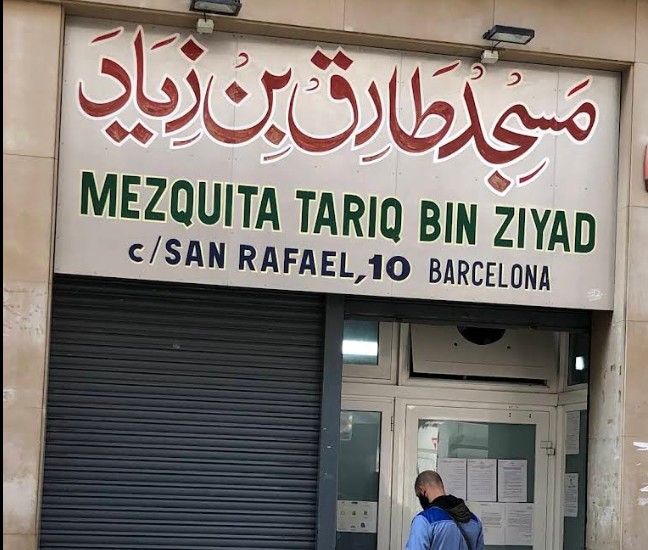
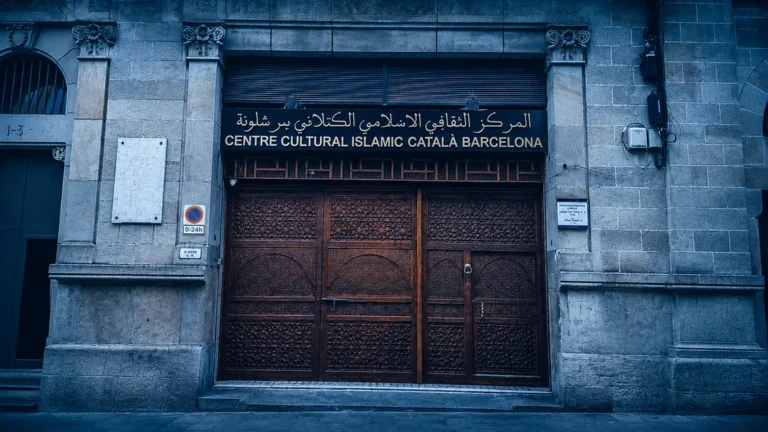
Façade of the Tariq Ibn Ziyad Mosque on Sant Rafael Street in Barcelona
Women's access only formally admitted
Although the mosque Tariq Ibn Ziyad Although it claims to admit women, various public testimonies from Muslim women describe a very different reality. In reviews published on Google Maps, one woman explains that she left “Very disappointed”after checking that “There were men in the women's section.”and that“We couldn't perform wudu or pray because there was no room for us.”, adding that he had to “to lose my prayer because I didn't feel safe”.
Another review relates that, after arriving there, “One of the men at the door told me that there was no designated area for women.”, and that inside “There were cleaning products blocking the passage.”These complaints do not describe an isolated incident, but a recurring practice: female access exists on paper, but Not guaranteed in practice, a fact that directly contradicts the public discourse of inclusion and normalisation that accompanies institutional visits.
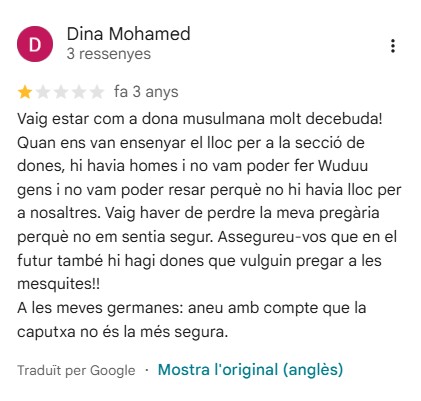
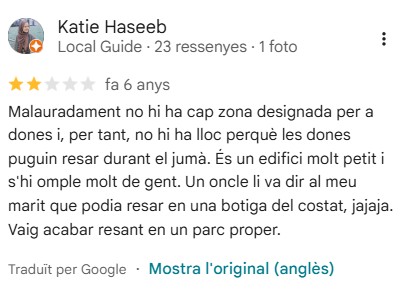
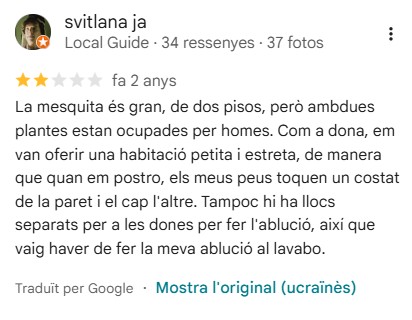
Some of the women's accounts explaining the situation at the Tariq Ibn Ziyad mosque.
A mosque without official registration: opacity and lack of guarantees
To this situation is added a particularly serious fact from an institutional point of view: The Tariq Ibn Ziyad mosque is not registered in the Register of Religious Entities of the Ministry of Justice.a, according to the official register. This registration is neither a minor nor a symbolic procedure: It is the mechanism that allows one to identify who legally represents the centre., what its governing bodies are, what its official address is and under which legal framework it operates.
Not being registered implies a lack of transparency, makes administrative oversight more difficult and prevents clear accountability on issues such as internal management, equal access or relations with institutions. The fact that an unregistered centre receives an official visit from a Government minister normalises an opacity that the Administration should, precisely, correct rather than endorse.
«Behind you is the sea; before you is the enemy. You have no choice but to win or die.»
This is the proclamation attributed to the man after whom the mosque is named. History says that Tariq ibn Ziyad delivered it after burning the ships with which he crossed the Strait of Gibraltar. The phrase lays bare, without embellishment, the essence of his historic action. It doesn't speak of dialogue, coexistence or cultural exchange: it speaks of total war, no return and the annihilation of the alternative.. The message is unequivocal: the only possible horizon is military victory or death. Thus the conquest of the Peninsula began in 711, as a religiously legitimised armed operation within the expansion of the Umayyad Caliphate.. Turning this figure today into a mere neutral “historical” reference is an exercise in whitewashing: the origin of Al-Andalus is not a myth of coexistence, but an imposition by force of a new political and legal order.
In the contemporary context, The figure of Tariq ibn Ziyad has been recovered and used by Islamist and jihadist discourses. as a symbolic reference linked to the narrative of Al-Andalus and the Islamic conquest of the Peninsula.
The institutional visit to the Tariq Ibn Ziyad mosque thus forms part of a series of decisions that focus on the criteria used by public authorities when engaging with certain religious centres. The symbolism of the name, the documented complaints about women's actual access, and the absence of registration in the Ministry of Justice's Register of Religious Entities. They set a scene that goes beyond protocol and mere institutional courtesy. In this context, official gestures cannot be analysed in isolation but as part of a relationship that demands knowledge, contextualisation and judgement, especially when it comes to granting public visibility and legitimacy.
More about Islam in Catalonia

The Guardia Civil arrests a jihadist in Vilanova i la Geltrú
Egypt designates Islamic organisation linked to Barcelona’s largest mosque as terrorist
They want to change the name of the Navas neighborhood so as not to offend Muslims
Police capture a muslim follower of Islamic State in his cave in Barcelona’s Raval neighborhood
A new Barcelona contract imposes the halal menu on social services
A Muslim is hunted down in Tarragona and another in Vilafranca del Penedès for jihadist activity.
The Catalan Government wants prayer rooms in companies so that muslims can pray

UK's top sharia court imam charged with rape

The Guardia Civil arrests a jihadist in Vilanova i la Geltrú

«Allahu Akbar» failed with a lighter and gas cylinders at a gas station in France


Muslim protesters shout «Allahu Akbar» outside a London restaurant for not serving halal.
Swedish public television exposes imams who help practice polygamy

Colorado Muslim Senator Creates Muslim-Only Work Placements
Egypt designates Islamic organisation linked to Barcelona’s largest mosque as terrorist
They want to change the name of the Navas neighborhood so as not to offend Muslims

Police capture a muslim follower of Islamic State in his cave in Barcelona’s Raval neighborhood

British school forces six-year-olds to wear hijabs during Islam class
Students at an Italian School Told to Pretend to Be Muslims in Catholic Religion Class
Figure of Jesus Christ beheaded and Arabic graffiti left on a monument to fallen British soldiers
Teenagers interrupt a mass in Vienna shouting “Allahu Akbar”
Phrase of the Week

Image of the Week
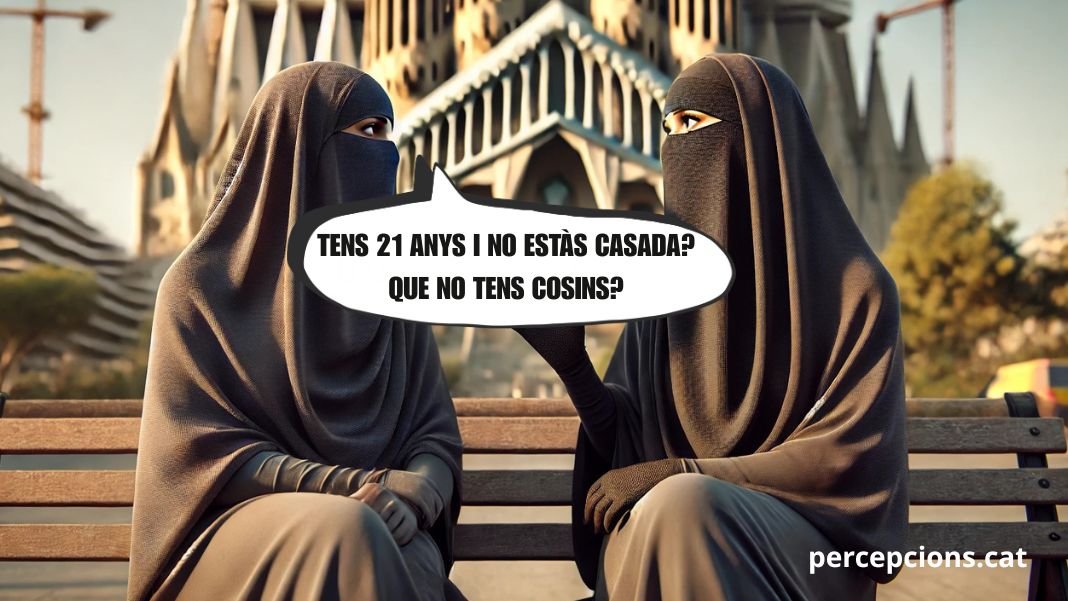
-Don't you have cousins?