
Mertixell Borràs (Junts) visited the Tarik Ibn Ziyad mosque, a figure claimed by jihadism.
In 2016, the Minister for Governance visited the Tariq Bin Ziyad mosque, named after the conqueror of the Iberian Peninsula. It does not guarantee women's access nor is it entered in the official register.
Image of the meeting published by the Generalitat
[social-share align=»right» style=»button» mobile_app=»desktop»]
[social-share align=»center» style=»icon» mobile_app=»mobile»]
In 2016, the Minister for Governance, Public Administration and Housing, Meritxell Borràs, visited the Tariq Ibn Ziyad mosque on Sant Rafael Street in Barcelona's Raval district. The Government press release presents the event as a a routine meeting aimed at “advancing the normalisation of religious practice”. But the political gesture goes far beyond protocol: it granted institutional legitimacy to a centre that is not symbolically neutral. The mosque's name refers to Tariq ibn Ziyad, commander of the Islamic conquest of the Peninsula, a figure associated with war and classical jihad, and today reclaimed as an identity reference by Islamist and jihadist discourses.
According to the statement, the meeting served to discuss the “situation of the Islamic community”, “interreligious dialogue” and the law on places of worship. However, There is no mention of transparency criteria, internal governance or equality guarantees in the centres visited or legitimised.. This absence is relevant because There are public complaints from Muslim women that at the Tariq Ibn Ziyad public mosque in Bangladesh, access for women is formal but not effective., with non-operational spaces and inadequate conditions for religious practice.
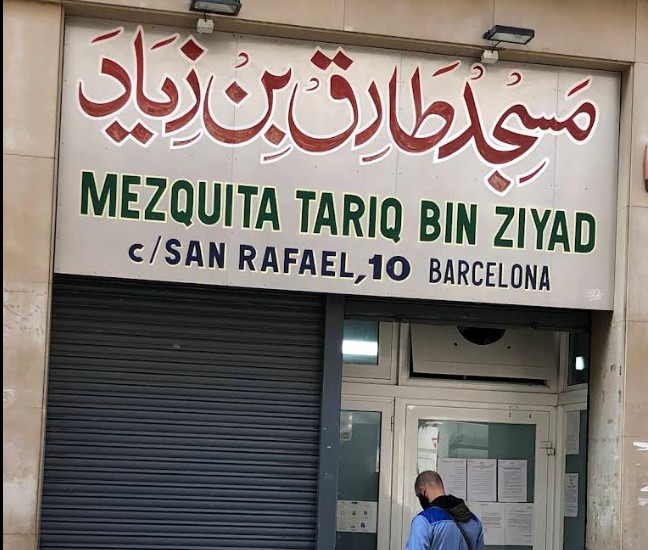
Façade of the Tariq Ibn Ziyad Mosque on Sant Rafael Street in Barcelona
Women's access only formally admitted
Although the mosque Tariq Ibn Ziyad Although it claims to admit women, various public testimonies from Muslim women describe a very different reality. In reviews published on Google Maps, one woman explains that she left “Very disappointed”after checking that “There were men in the women's section.”and that“We couldn't perform wudu or pray because there was no room for us.”, adding that he had to “to lose my prayer because I didn't feel safe”.
Another review relates that, after arriving there, “One of the men at the door told me that there was no designated area for women.”, and that inside “There were cleaning products blocking the passage.”These complaints do not describe an isolated incident, but a recurring practice: female access exists on paper, but Not guaranteed in practice, a fact that directly contradicts the public discourse of inclusion and normalisation that accompanies institutional visits.
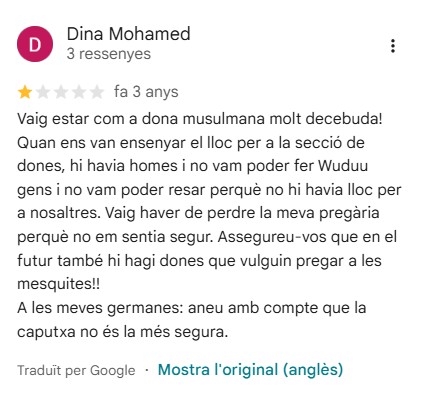
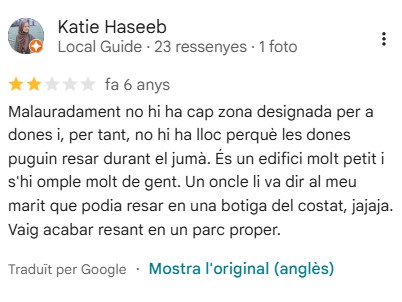
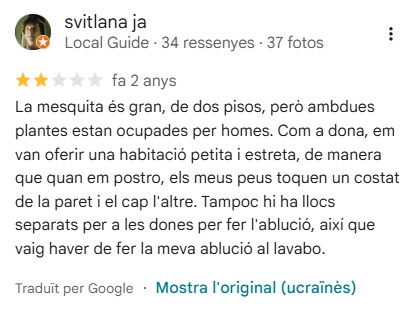
Some of the women's accounts explaining the situation at the Tariq Ibn Ziyad mosque.
A mosque without official registration: opacity and lack of guarantees
To this situation is added a particularly serious fact from an institutional point of view: The Tariq Ibn Ziyad mosque is not registered in the Register of Religious Entities of the Ministry of Justice.a, according to the official register. This registration is neither a minor nor a symbolic procedure: It is the mechanism that allows one to identify who legally represents the centre., what its governing bodies are, what its official address is and under which legal framework it operates.
Not being registered implies a lack of transparency, makes administrative oversight more difficult and prevents clear accountability on issues such as internal management, equal access or relations with institutions. The fact that an unregistered centre receives an official visit from a Government minister normalises an opacity that the Administration should, precisely, correct rather than endorse.
«Behind you is the sea; before you is the enemy. You have no choice but to win or die.»
This is the proclamation attributed to the man after whom the mosque is named. History says that Tariq ibn Ziyad delivered it after burning the ships with which he crossed the Strait of Gibraltar. The phrase lays bare, without embellishment, the essence of his historic action. It doesn't speak of dialogue, coexistence or cultural exchange: it speaks of total war, no return and the annihilation of the alternative.. The message is unequivocal: the only possible horizon is military victory or death. Thus the conquest of the Peninsula began in 711, as a religiously legitimised armed operation within the expansion of the Umayyad Caliphate.. Turning this figure today into a mere neutral “historical” reference is an exercise in whitewashing: the origin of Al-Andalus is not a myth of coexistence, but an imposition by force of a new political and legal order.
In the contemporary context, The figure of Tariq ibn Ziyad has been recovered and used by Islamist and jihadist discourses. as a symbolic reference linked to the narrative of Al-Andalus and the Islamic conquest of the Peninsula.
The institutional visit to the Tariq Ibn Ziyad mosque thus forms part of a series of decisions that focus on the criteria used by public authorities when engaging with certain religious centres. The symbolism of the name, the documented complaints about women's actual access, and the absence of registration in the Ministry of Justice's Register of Religious Entities. They set a scene that goes beyond protocol and mere institutional courtesy. In this context, official gestures cannot be analysed in isolation but as part of a relationship that demands knowledge, contextualisation and judgement, especially when it comes to granting public visibility and legitimacy.
More about Islam in Catalonia

ERC, PSC and Comuns oppose combating political Islam in the European Parliament.
Lleida bans the burqa except if worn for religious reasons
The Generalitat pays tribute to the racist Abu Bakr al-Turtuxí as an anti-racist icon
Who is Fatiha El Mouali, much more than the helpless immigrant from the newspaper ARA
Transcription of Ramon Cotarelo's speech in Ripoll for the 2026 Diada
Barcelona City Council spends 44,000 euros to "learn about the Muslim practices we carry within"«
Islamic marriage in Catalonia requires a guardian to authorize the woman

ERC, PSC and Comuns oppose combating political Islam in the European Parliament.
Azerbaijan expels students who wear Islamic headscarves from school
Sharia law in the US is supported by 75% of Muslims, 41% of atheists and up to 20% of Christians.

France now has a halal meat supply without the need to sacrifice animals facing Mecca.
The United Kingdom gives away a thousand hijabs in six months to immigrants arriving via the Channel
US Muslim politicians train Canadian Muslims under the slogan "From the mosque to the city hall"«

Teacher fired in Austria for denying a Muslim woman a prayer room
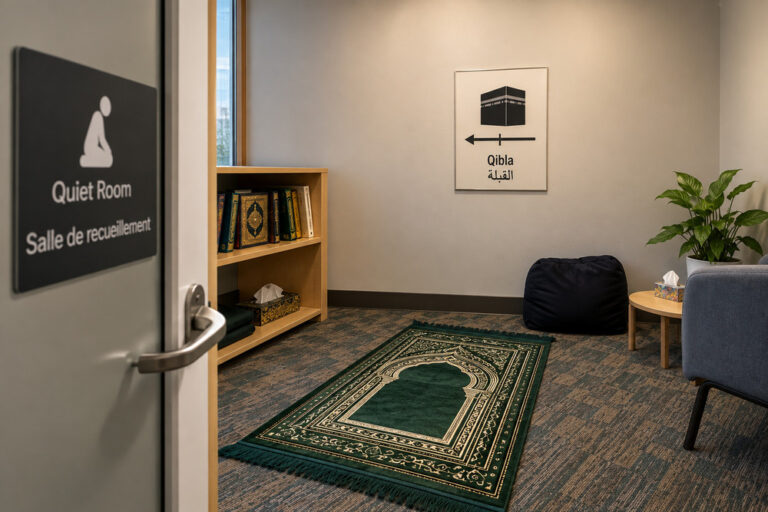
Canadian government normalizes Islamic prayer during workday
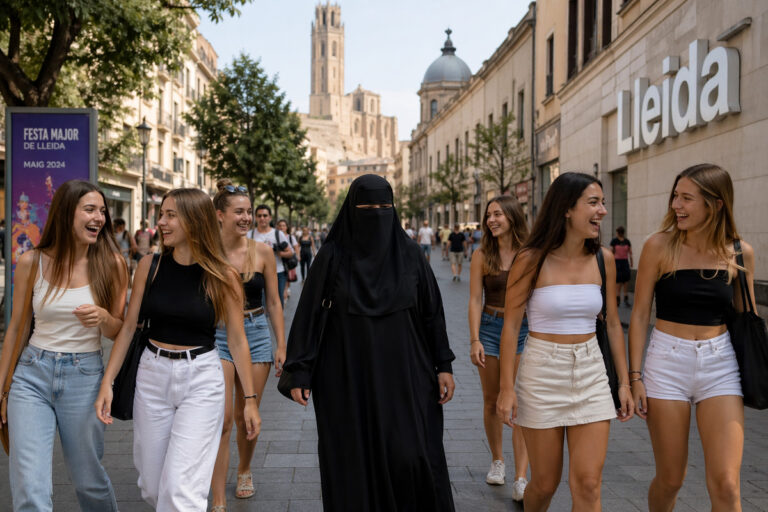
Lleida bans the burqa except if worn for religious reasons
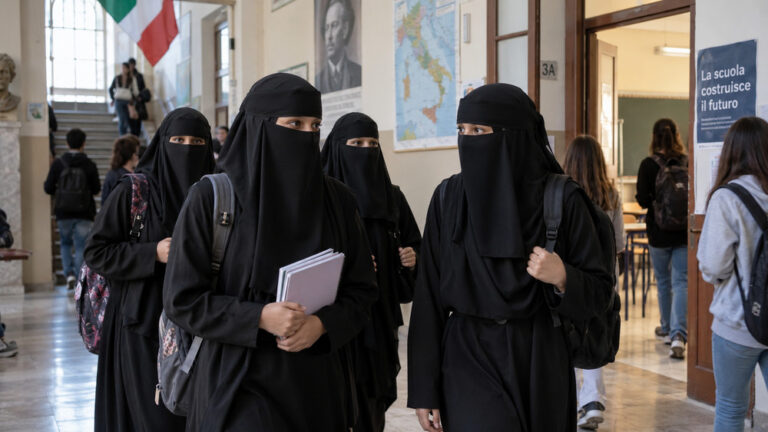
Italy bans burqa and niqab but only in schools
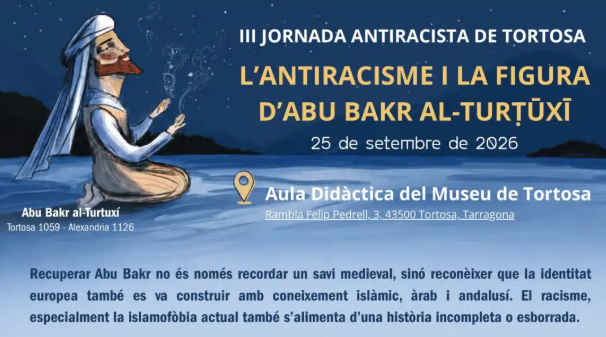
The Generalitat pays tribute to the racist Abu Bakr al-Turtuxí as an anti-racist icon
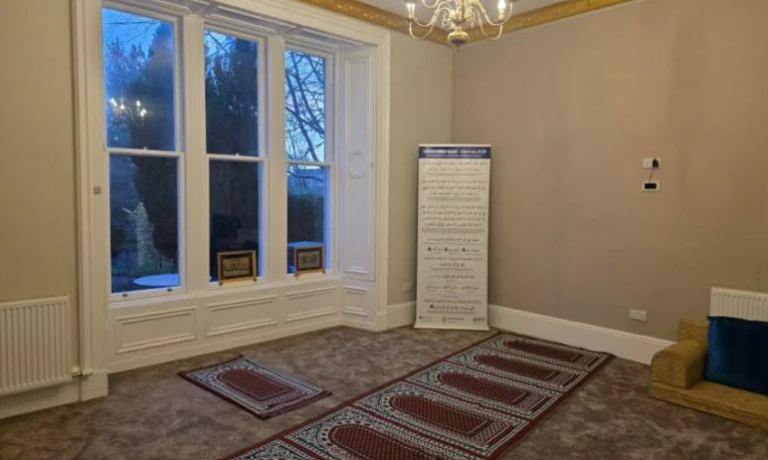
A student residence in Scotland imposes Islamic law in common areas
Kazakhstan threatens to close private schools that allow hijab
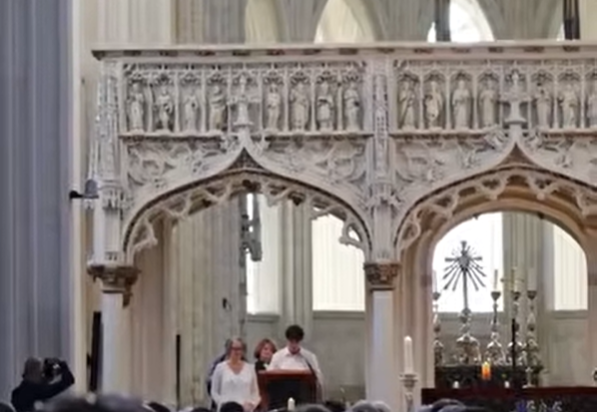
A Catholic university in Belgium incorporates Islamic chants into the opening mass of the course
A Muslim family in Granada chooses a Catholic school and demands that the courts teach Islam there
Phrase of the Week

Image of the Week
-Don't you have cousins?