
Who is Fatiha El Mouali, much more than the helpless immigrant from the newspaper ARA
She arrived in Catalonia for family reunification and is now a doctor and professor at the UAB. She says that the racist system prevents Moroccans from becoming professors.
Fatiha El Mouali has appeared in the newspaper ARA, presented as a Moroccan woman who arrived in Catalonia in 2000 for family reunification but was trapped by legislation that allowed her to reside but not work. The portrait focuses on the discrimination, stereotypes and racism she claims to have suffered since her arrival.
But this is only a fragment of his career. Twenty-six years later, El Mouali is a doctor in Education, university professor, former municipal reception technician, researcher and anti-racist activist.. He portrays Catalan society as racist, but it is precisely in this society where he has developed a remarkable academic, professional and institutional career.
Not validating Morocco's title is racism
Mouali arrived in Catalonia in 2000 with studies in Economics and university experience in Morocco. He explains what happened ten years trying to validate the degree. Over the years, this experience would become one of the foundations of his discourse on institutional racism: considers that the lack of recognition of foreign qualifications contributes to relegating qualified immigrants to jobs below their qualifications.
In an interview with Mektub, in April 2026, he summarizes it this way: “our difficulties were not personal failures of adaptation, but barriers designed by the system itself”. The paradox is that, despite these barriers, he would end up working in a public administration and getting a doctorate in Education in Catalonia. This, however, does not lead her to qualify her diagnosis about the country that has welcomed her, but quite the opposite: she asserts that Catalonia is racist.

The system is racist but it pays the bill
Less than a decade after arriving in Catalonia, Fatiha El Mouali already worked within the Catalan public administration. The first reference is from 2009, when appears as a reception technician for the Granollers City Council. His job was precisely to orient newcomers and help them navigate the country's services and legislation. It seems that a system that pays him a salary for a job with a table, chair and air conditioning is still not good enough.
A few years later, this professional activity began to be accompanied by increasingly visible activism. In February 2015 participates at the University of Barcelona in the central act of the campaign #StopIslamophobia, promoted by the subsidized entities Unitat Contra el Fascisme i el Racisme (UCFR) and SAFI, with tables on Islamophobia “in institutions, in the media and on the streets”.
Despite describing Catalan society as racist and exclusionary, Fatiha El Mouali was already listed in 2020 as an associate professor at the Autonomous University of Barcelona. It is precisely in that academic field where she would also end up consolidating her career as a researcher and doctor in Education. Her personal situation contrasts with what she had stated a year earlier, in 2019, at a conference in Granada: that after decades of Moroccan presence, doctors, teachers or professionals in prestigious spaces continued to be uncommon because, according to her, “The intention is to prevent these people from reaching these spaces and these types of professions.”
Fatiha El Mouali enters the Colau City Council
The arrival of Ada Colau at the City Council opened a new opportunity for many Islamic activists to collect money from the administration and at the same time put pressure on it. Fatiha El Mouali was one of the people who entered this new institutional circuit. The result arrived in 2017, with the elaboration of the Municipal Plan to fight against Islamophobia. El Mouali is among the people consulted by the City Council, alongside profiles such as Tariq Ramadan, grandson of the founder of the Muslim Brotherhood; Najia Lotfi, the halal banker from Barcelona; or Saloua El Gharbi, the Muslim from Junts. The process was not limited to condemning aggressions or insults, but contributed to building a much broader framework on what should be considered Islamophobia.
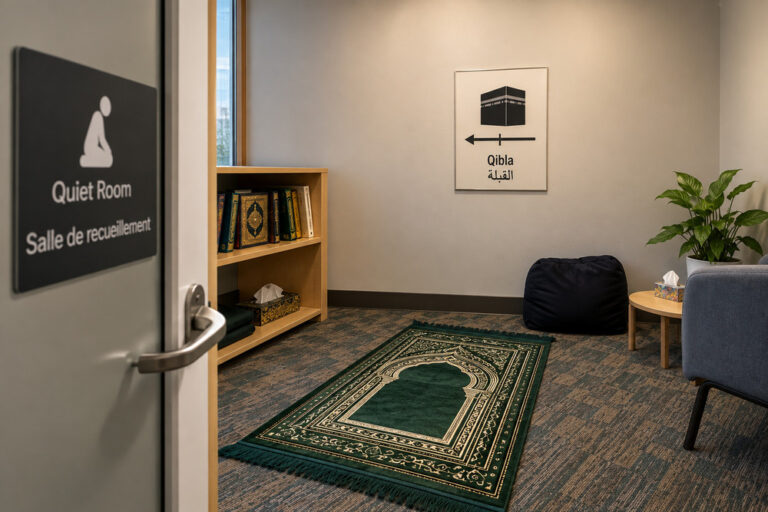
Among the situations defined as Islamophobia were issues such as not having spaces to pray at work, not adapting schedules to prayers, the critical view of the hijab or the lack of religious accommodations in public services. In other words, the debate was no longer just about protecting Muslim people from discrimination, but also adapt institutions and services to specific religious practices. It is at this point that El Mouali's activism ceases to be just denunciation and begins to participate directly in the definition of public policy.
Catalan schools are also racist
Since 2019, El Mouali has placed the Catalan school at the center of his denunciation. His thesis is not that conflicts can arise due to simple cultural misunderstandings, but that the education system reproduces racial hierarchies. In 2021 stated to The Education Journal that "some of the teachers" have a "xenophobic or racist" view“, that the treatment of Moroccan mothers is done “from a superior point of view” and that “people don't want to mix with immigrant families”. He also accuses the school of “criminalizing” the parenting styles of «migrant» families and thus avoiding “auditing their own racism”. In 2025 he wrote in The Disruptive that Living in a “classist, racist, xenophobic, sexist, unequal” society inevitably implies reproducing these patterns within educational centers..
Mouali argues that Moroccan mothers are stereotyped as ignorant and submissive women and that this view also affects their children. He later sums it up with a direct accusation: “"some teachers are not aware of it, that they have a xenophobic or racist view"”. He will also state that “people don't want to mix with immigrant families” and that this attitude contributes to school segregation.
Thanks to the burkini, feminists can go to the beach
In 2016, in the midst of the French controversy over the burkini, El Mouali defended it as a matter of women's freedom. As spokesperson for Unitat Contra el Fascisme i el Racisme, she participated in a protest in front of the French Consulate in Barcelona. El País reported one of her most forceful statements at the time: she asserted that the fight against the burkini "the only thing that helps is the radicals.".
In an interview published that same year by Izquierda Diario, El Mouali explained that he was I had lived in Catalonia for sixteen years and had never been to the beach., and presented the burkini as the garment that finally allowed her to bathe in it without giving up her way of dressing. In the face of feminist sectors in favor of banning it, she responded: “if feminism believes that banning the burkini will help women wear bikinis [...] it is wrong, and very wrong”. And he added that banning it made “a great favor to the fundamentalists who go in the name of Islam”.
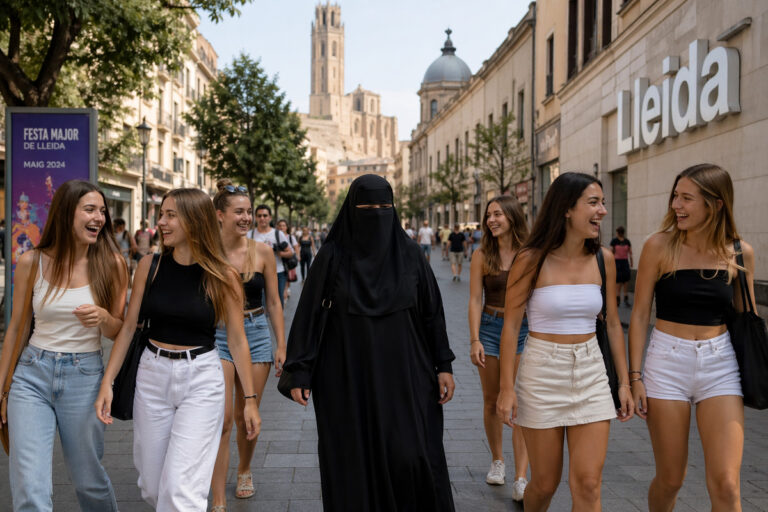
The same idea would reappear in 2017 in statements to The Country, when El Mouali stated that “The essence of feminism is to defend the freedom to decide”, also in reference to the Islamic veil. Her approach thus turns classical feminist criticism on its head: Covering the body for religious reasons can be emancipatory, while questioning this practice is a form of racism and Islamophobia.

From victim of the system according to ARA to wanting to exercise political power
The portrait of the’NOW of September 14, 2026 emphasizes an El Mouali trapped by administrative structures. She recalls that she arrived for family reunification with a residence permit that did not allow her to work and includes her denunciation of an Immigration Law that, according to her, condemned her to fulfill the stereotype of a woman dedicated to “taking care of her children and husband”. It is the image of an immigrant whom the system prevents from fully integrating into the society that has welcomed her.
But Mouali has been questioning precisely this idea of integration for years.. In an interview held on March 24, 2018 at the CIEMEN headquarters, as part of a program by the Xarxa Itaca, with Maria Dantas (Esquerra Republicana), he rejected the idea that the migration process should end with the children of immigrants integrated into a homogeneous society. He explained that he had left behind that approach according to which “The first generation costs a bit, but over time the children will integrate and we will reach a homogeneous society.”.
The discourse reaches a directly political formulation in 2026. In an interview with Mektub, El Mouali no longer speaks simply about overcoming administrative barriers or achieving representation. Defense “"occupy decision-making spaces"” not as symbolic presences, but as “pressure blocks”, and claims to pass “from complaint activism to the exercise of political power”. The goal, he says, is to stop being “victims of the system” and become “architects of a new society”. And when they ask him if it is necessary to be within the institutions, he answers yes, but “under our conditions”, to “open cracks, make uncomfortable and question the architecture of privilege from within”.
It is the part that disappears from the portrait of the ARA: the woman presented primarily as a victim defends herself today enter their decision-making centers, organize themselves politically and transform their rules from within. The result is that a person who has been receiving public wages for more than 15 years presents the system as a racist structure that needs to be contested and transformed.
More Perceptions of
More about Catalonia

Lleida bans the burqa except if worn for religious reasons
The Generalitat pays tribute to the racist Abu Bakr al-Turtuxí as an anti-racist icon
Transcription of Ramon Cotarelo's speech in Ripoll for the 2026 Diada
Barcelona City Council spends 44,000 euros to "learn about the Muslim practices we carry within"«
Islamic marriage in Catalonia requires a guardian to authorize the woman
El projecte Barxiluna va convertir 80 anys d’al-Àndalus en un deute etern de Barcelona amb l’islam

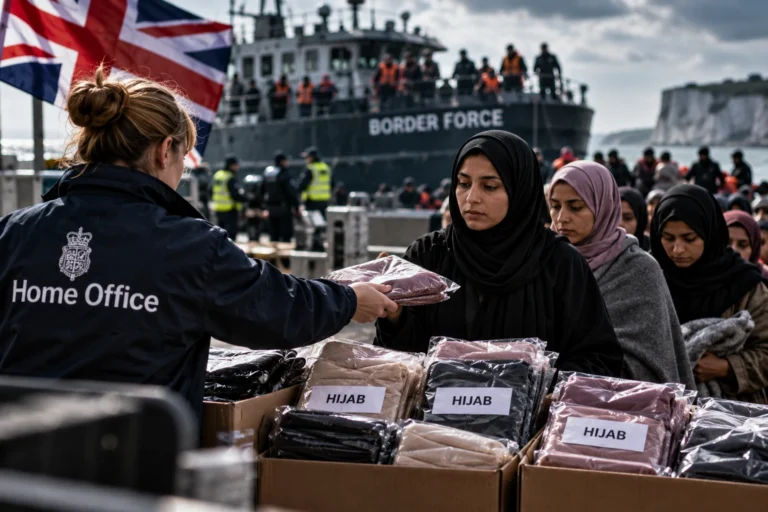
The United Kingdom gives away a thousand hijabs in six months to immigrants arriving via the Channel
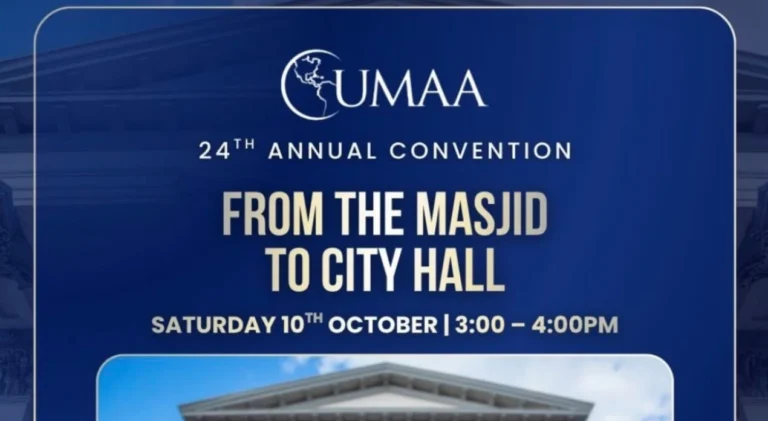
US Muslim politicians train Canadian Muslims under the slogan "From the mosque to the city hall"«
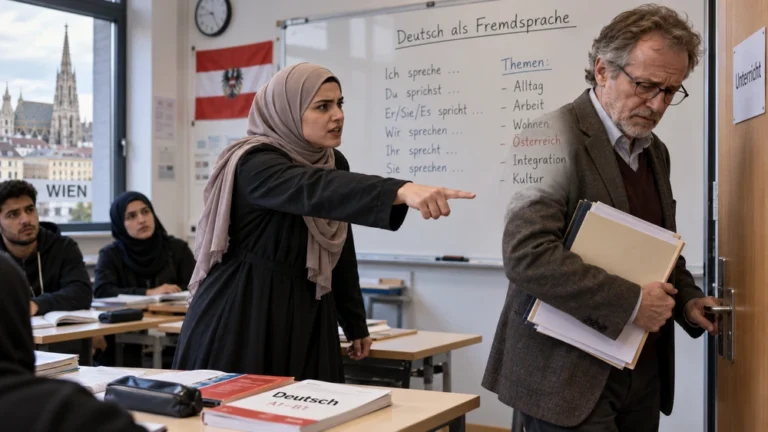
Teacher fired in Austria for denying a Muslim woman a prayer room
Canadian government normalizes Islamic prayer during workday
Lleida bans the burqa except if worn for religious reasons
Italy bans burqa and niqab but only in schools
The Generalitat pays tribute to the racist Abu Bakr al-Turtuxí as an anti-racist icon
A student residence in Scotland imposes Islamic law in common areas
Kazakhstan threatens to close private schools that allow hijab
A Catholic university in Belgium incorporates Islamic chants into the opening mass of the course
A Muslim family in Granada chooses a Catholic school and demands that the courts teach Islam there
Convicted in Mallorca for gender violence for imposing the hijab, controlling and assaulting
Muslim teacher in Flanders prefers unemployment to taking off her hijab
Even Kadyrov's Islamized Chechnya doesn't want women with their faces covered with the niqab
Feminist strike in Austria to defend the Islamic veil for children under 14
Phrase of the Week

Image of the Week
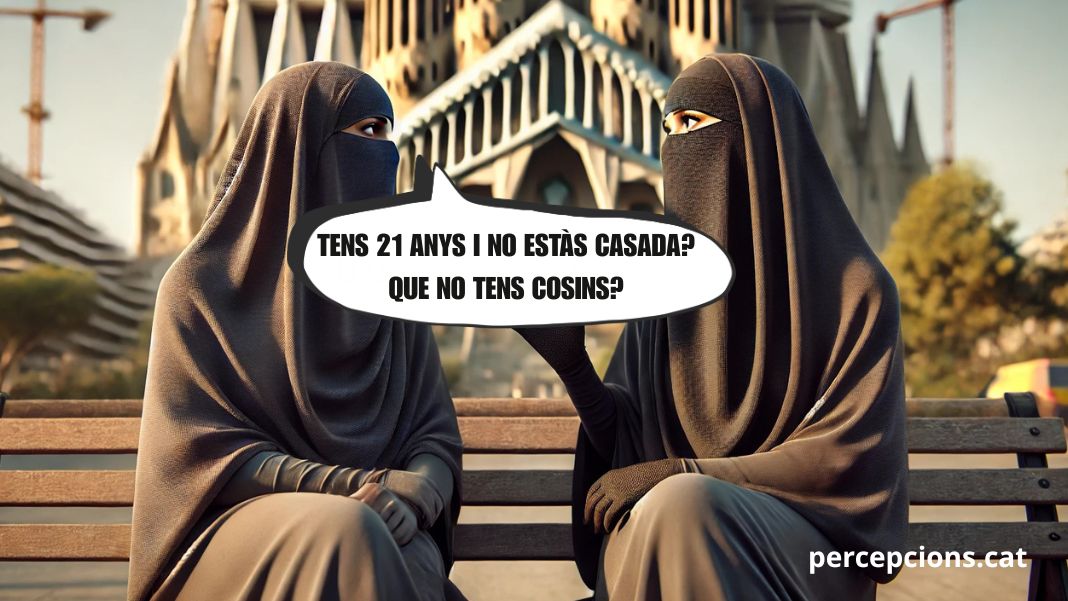
-Don't you have cousins?