
Barcelona prioritizes Arabic and Urdu in hiring municipal service personnel
Contracts for civic centers, toy libraries, school playgrounds or climate shelters require up to 30% of workers with cultural diversity.
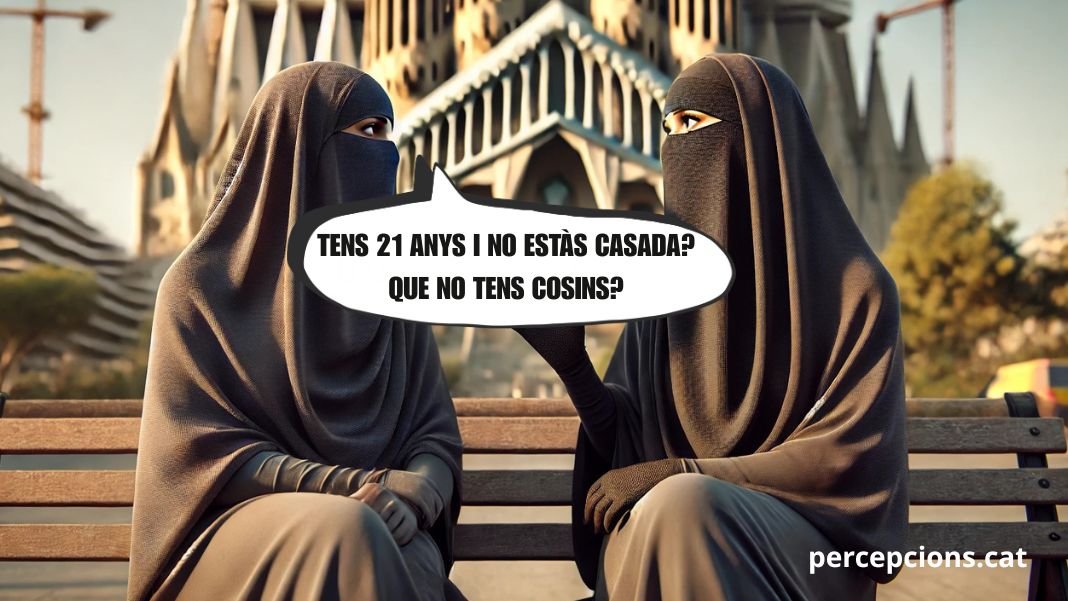
Illustrative image// AI
[social-share align=»right» style=»button» mobile_app=»desktop»]
[social-share align=»center» style=»icon» mobile_app=»mobile»]
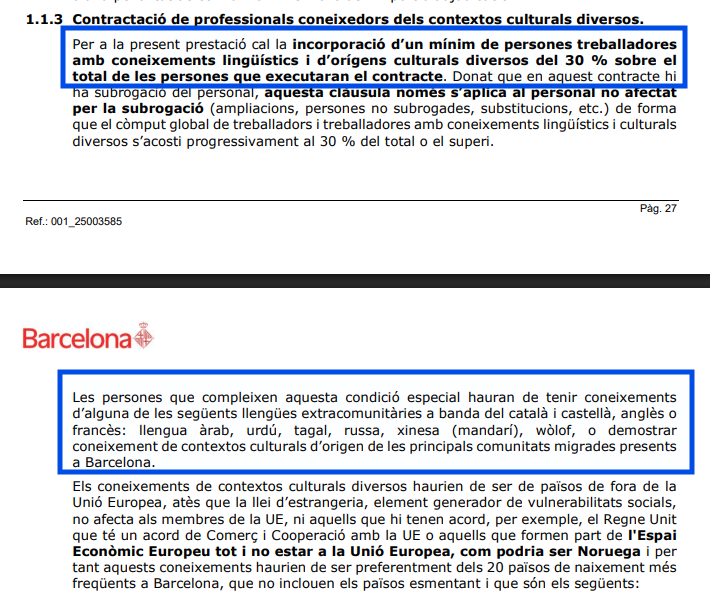
Companies that manage certain personal care services for Barcelona City Council are required to adjust the cultural composition of the templates to reflect the cultural diversity of the neighborhoods. This implies that companies must reserve jobs for people with ties to non-EU countries. The City Council justifies this employment preference by arguing that «the immigration law, an element that generates social vulnerabilities, does not affect EU members» (Open School Playgrounds contract in the Neighborhood, file 001_25003585).
The premise of this cultural diversity policy is that workers are needed who know the cultural codes and languages of the people of Barcelona. For this reason, The City Council prioritizes workers who speak Arabic, Urdu, Chinese, Tagalog, Russian, Hindi or Wolof. This policy stems from a municipal instruction approved in May 2022, during the government of Ada Colau. The government of Jaume Collboni has maintained and expanded it with measure 1.5.1, «Unification of anti-racist clauses in hiring», from Barcelona Anti-Racist Plan 2026-2036, presented by the PSC government in an act with representatives of Junts, Comuns, ERC and the PP.».
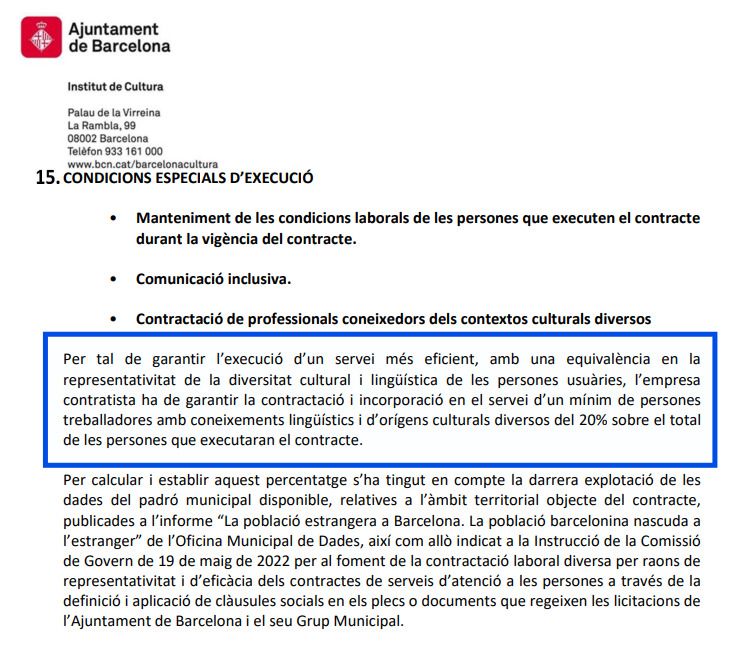
The percentage of diverse workers depends on the weight of the foreign-born population in the neighborhood where the service is provided. When this represents between 25% and 40% of the population, The City Council imposes a minimum quota of 20% of the workforce. When it exceeds 40%, the quota rises to 30%. The municipal instruction allows these percentages to be increased if the contracting body justifies it. These are not recommendations, but special execution conditions that the awarded companies are obliged to comply with if they want to work with the City Council.
Civic centers, neighborhood clubs and sports facilities
The quotas for workers with cultural diversity affect municipal facilities intended for all residents. Among the contracts that include the condition are those for civic centers, neighborhood centers, sports facilities, school playgrounds, youth services or climate shelters. For example, the contract to manage the civic centers of Parc Sandaru, Sant Martí i el Besòs and el Maresme during the years 2027 and 2028 (file 001_26001915), with a budget of 3.46 million euros. The diversity quotas are 20% in the first two facilities and 30% in the third. There is also a 20% quota in the neighborhood centers of Can Baró, la Barraca del Carmel and Mas Guinardó (file 001_26000544).
The demands also reach the selection of monitors who look after children in school playgrounds. The program contract Schoolyards Open in the Neighborhood, with an approximate budget of one million euros, includes a 30% quota (file 001_25003585There are also diversity clauses in Fabra i Coats contracts (file 006_25002059) and the Sant Martí Youth Service (file 001_26003251). Even climate shelters are subject to these requirements. The Sant Andreu climate shelters contract (file 001_26001076) establishes a quota of 20% of workers of diverse origin.
The origin of parents as a hiring criterion
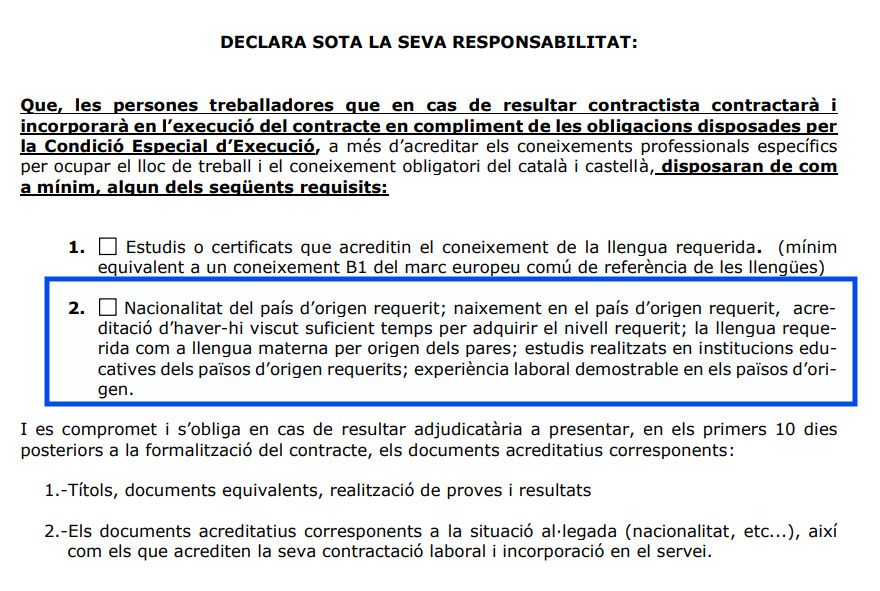
To accredit compliance with cultural and linguistic diversity quotas, The City Council accepts the nationality, country of birth and mother tongue of the workers' family origin.. This last circumstance is expressly stated in Annex 4 (page 53) of the management contract for the Open School Playgrounds in the Neighborhood program, which establishes a quota of 30%. The same wording appears in Annex 5 of the Sant Andreu climate shelters contract. In both cases, the folds literally collect «the language required as mother tongue due to the parents» origin" among the ways of accrediting the requirements demanded of workers.
The City Council accepts having resided, studied or worked in one of the required countries of origin. In September 2022, when consulted by a bidding company, the council confirmed that it was not necessary to simultaneously prove the linguistic requirements and those of ties to the country of origin. The specifications require, in any case, that knowledge be sufficient and adequate, but do not establish a specific test to evaluate cultural knowledge.
Arabic, Urdu or Tagalog to serve Barcelona residents
The Barcelona City Council specifies in some contracts which foreign languages municipal service workers must know. Among the languages it prioritizes are: Arabic, Urdu, Chinese, Tagalog, Russian, Hindi and Wolof. The selection of linguistic profiles responds to the weight of the different foreign communities in the city. As the foreign-born population in a neighborhood increases, the percentage of workers who must prove this knowledge may also increase.

These requirements appear in the contract for management and revitalization of the outdoor play space 0-99 (001_25004275), with an estimated value of 591,745 euros, and at management contract for children's services and toy libraries in Sants-Montjuïc (001_25004410), with a budget of 1.47 million euros. The latter incorporates Punjabi among the reference languages and establishes a quota of 20%. The linguistic requirements established by the City Council they also affect the selection of personnel responsible for organizing children's activities and energizing municipal toy libraries. These requirements appear in the contract for management and revitalization of the outdoor play space 0-99 (001_25004275), with an estimated value of 591,745 euros. There is also a contract for the management of children's services and toy libraries in Sants-Montjuïc (001_25004410). The latter incorporates Punjabi among the reference languages and establishes a quota of 20%. Knowledge of non-EU languages thus becomes a selection criterion for personnel responsible for energizing play spaces and children's activities.
The specifications set a minimum level equivalent to B1 to accredit knowledge of the required foreign languages and allow companies to conduct language tests on candidates. On the other hand, the cultural and linguistic diversity clause of Sant Andreu climate shelters contract (001_26001076) requires knowledge of Catalan without specifying the level.
200,000 euros to monitor diversity
On February 13, 2026, Barcelona City Council awarded the QSL Cultural Services, SL a contract with an estimated value of 196,139 euros (001_25003315) to supervise the application of cultural diversity clauses in municipal contracts for the care of people and promote the incorporation of candidates with these profiles into the City Council's personnel selection processes. The contract, promoted by the Department of Interculturality and Religious Pluralism, was awarded for 116,692 euros including VAT for the first year of execution. QSL presented the only valid offer.
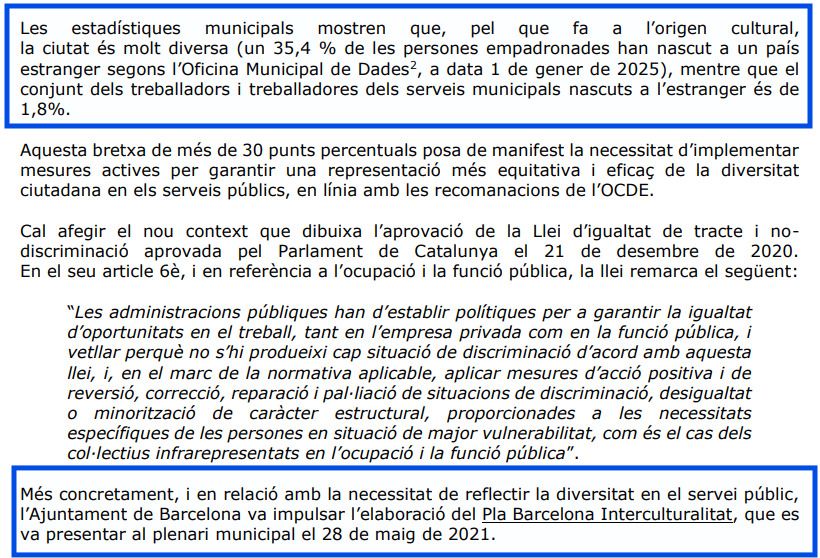
On page 4 of the’contract justification report, The City Council argues that 35.4% of Barcelona residents were born abroad, while among municipal service workers this percentage is 1.8%. The document justifies the proposed measures by ’the need to reflect diversity in the public service«. With this objective, the council plans set quantitative objectives for increasing staff of diverse origin, organize campaigns to publicize municipal elections and offer specific training to candidates from underrepresented groups. Among the services where the City Council wants to increase the cultural diversity of its staff is the Guàrdia Urbana.
Four years after Ada Colau's government introduced cultural diversity quotas in the contracting of municipal services, Jaume Collboni's government wants to transfer this policy to the selection of City Council personnel.. To account for the diversity of the municipal workforce, the council proposes going back a generation and registering, in addition to the workers' mother tongue, the country of birth of the father and mother. The objective is to have data that allows the identification of underrepresented groups and to set numerical targets to increase their presence. Thus, the cultural and family origin of the workers acquires weight in the personnel policy of the council, both in the services that the City Council outsources to private companies and in those that it provides directly.

More Perceptions of
More about Catalonia

Two repeat jihadists aged 19 and 20 arrested in Sitges and Montcada
The Guardia Civil arrests a jihadist in Vilanova i la Geltrú
Egypt designates Islamic organisation linked to Barcelona’s largest mosque as terrorist
They want to change the name of the Navas neighborhood so as not to offend Muslims
Police capture a muslim follower of Islamic State in his cave in Barcelona’s Raval neighborhood
A new Barcelona contract imposes the halal menu on social services
A Muslim is hunted down in Tarragona and another in Vilafranca del Penedès for jihadist activity.


Two repeat jihadists aged 19 and 20 arrested in Sitges and Montcada

Bomb threats with «Allahu Akbar» against a thousand schools in Germany and Denmark

UK's top sharia court imam charged with rape

The Guardia Civil arrests a jihadist in Vilanova i la Geltrú
«Allahu Akbar» failed with a lighter and gas cylinders at a gas station in France


Muslim protesters shout «Allahu Akbar» outside a London restaurant for not serving halal.

Swedish public television exposes imams who help practice polygamy

Colorado Muslim Senator Creates Muslim-Only Work Placements
Egypt designates Islamic organisation linked to Barcelona’s largest mosque as terrorist
They want to change the name of the Navas neighborhood so as not to offend Muslims

Police capture a muslim follower of Islamic State in his cave in Barcelona’s Raval neighborhood

British school forces six-year-olds to wear hijabs during Islam class

Students at an Italian School Told to Pretend to Be Muslims in Catholic Religion Class
Phrase of the Week

Image of the Week
-Don't you have cousins?