
Younger French Muslims are more religious, radical and conservative than previous generations.
74.1 per cent of those under 25 consider that Sharia law should be above the laws of the Republic.
Illustrative image
Space Manager
[social-share align=»right» style=»button» mobile_app=»desktop»]
[social-share align=»center» style=»icon» mobile_app=»mobile»]
According to the surveys carried out by Ifop in the years 2020 i 2023, 571 per cent of young Muslims in France believe that Islamic religious law should take precedence over the laws of the French Republic. This figure represents a significant increase compared with 2016, when the percentage was 471 per cent. The most marked increase is seen among among those under 25, where the percentage rises to 74% in 2023, compared with the 47% shown in the 2020 survey.
The younger they are, the more radical they are.
The generational difference is clear. While support for the primacy of Sharia law decreases among older generations, the opposite trend is observed among young people: As the age decreases, rejection of the French legal hierarchy in favour of religious precepts increases..
The new generation of French Muslims, many of whom were born in the country, seems increasingly Far from republican values, of secularism and of the coexistence that for decades had been the pride of France.
The growing weight of religion
The 78% of Muslims in France consider that secularism, as it is currently applied, It is discriminatory towards Muslims.. But when we look at the age brackets, The perception of discrimination clearly increases among the youngest.:
- 89.1% of Muslims under the age of 25 believe that secularism is discriminatory.
The school under pressure
The data collected by Ifop reveal a Growing pressure to adapt the education system to religious values and practices of a significant proportion of Muslim students, especially among the younger and practitioners.
The survey asks about the ban on the veil, school exemptions and situations they have encountered. The data are clear:
- The 81% of Muslims under 25 years of age opposes the ban on headscarf and the’a long robe the girls. In contrast, among those over 25 it falls to 66%.
Exemptions from taking part in certain subjects such as science, music, sex education or swimming if they conflict with religion are also increasingly sought by younger generations:
- 48.1 per cent of those under 25 support the right not to take certain subjects. Among 24- to 34-year-olds it falls to 31.1 per cent, but among those over 35 only 15.1 per cent consider it appropriate.
School, for many young Muslims, is not only a place of academic learning but also a space where religious practices, social norms and cultural conflicts come into play. According to the Ifop survey, Muslim and non-Muslim pupils have experienced situations such as:
- 59% have witnessed prayers inside the school premises.
- 57% have seen pupils refusing to shake hands with others for religious reasons.
- 52% have seen girls absent from PE or swimming lessons for religious reasons.
- 51% have heard homophobic or sexist comments justified by religion.
- 43% have observed requirements for religious menus (halal, etc.) to be served in the school canteen.
- 30% have seen exclusionary practices in the canteen towards non-Muslim students.
- On 30 January, % witnessed a refusal to share mixed activities between boys and girls on religious grounds.
Faith above all science
One of the most surprising aspects of the 2023 Ifop survey is the view they have. French young Muslims on science. Far from presenting itself as a generation open to rational and empirical thought, a large majority continues to put religion above scientific knowledge.
For many of these young people, Religion not only guides morality or conduct., but also It is the ultimate source of truth about the physical world, creation, and even the laws of nature.. The data on those under 25 are clear:
- The 79% Under-25s believe that Religion is right over science. if there is a contradiction. The figure falls to 69% among Muslims over the age of 35 but remains far from the 19% for the general population.
This data They contradict the idea that younger generations are automatically more secularised or open to scientific knowledge.
Religious tolerance at a minimum
Despite living in a plural and secular society like the French one, A large proportion of young Muslims show attitudes of closed-mindedness or rejection towards other religions and worldviews.. This trend is clearly reflected in the Ifop survey, where it is noted that The value of religious tolerance is not as widely shared as one might expect. within this group, especially among those under 25.
Far from showing an open attitude towards diversity of beliefs, Many young Muslims advocate an exclusive view of the faith., where only one religion can be true and where the others are ignored, rejected or perceived as wrong. The data speak clearly once again:
- The 75% They state that There is only one true religion. (his/her). Only 17% of the general population defend this idea.
- The 60% does not accept matrimony.marriage between a Muslim person and someone of another religion.
- Only the 48% of school-educated young Muslims They say they are comfortable having a teacher of another religion.. The rest of the students don't care about the 80%.
Adaptation of public space to religious norms
One of the most visible fractures between the Muslim community and the rest of French society is that which occurs in the public sphere. Issues such as the burkini, gender-segregated opening hours at municipal swimming pools or the right to dress according to religious precepts are concrete examples where Religious values come into direct conflict with the customs of the rest of the inhabitants of France. Some of the data are as follows:
- The 84% of the Muslims respondents They are in favour of allowing the burkini. in public swimming pools. On the other hand, only 26% of the general French population Approve this possibility.
- The 81% of the Muslims They argue that that the municipal swimming pools have hours reserved for women, for reasons of religion or modesty. Only 21% of the total population accept it.
This support for differentiated religious measures It is even higher among practising Muslims., and among the younger ones, who see these options not as privileges, but as a matter of respect and religious freedom.
A colossal challenge for France… and for the West
The data collected throughout this article are not just statistics: They are the reflection of a a profound change that shakes the cultural and institutional foundations of French society. They speak of a young, Muslim and increasingly religious generation, that She does not feel represented by Republican values. nor for the secular vision of public space. A generation that Distrust science, prioritise religious law over civil law., and does not always share universal principles such as freedom of expression, gender equality or interreligious tolerance.
But the challenge goes far beyond France. What is being experienced today in the suburbs of Paris or in the classrooms of Lyon, It could be a mirror of what all of Western civilisation will live through tomorrow.: increasingly diverse societies, where A section of their young people reject mainstream culture and take refuge in closed, exclusive religious identities..
More Perceptions of
.
Phrase of the Week

Image of the Week
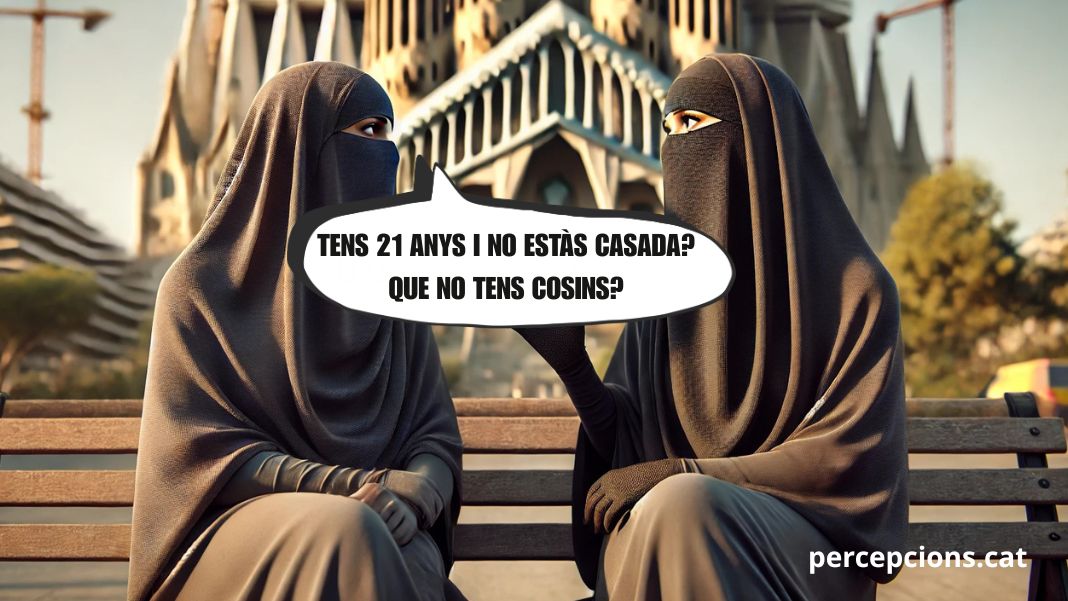
-Don't you have cousins?